.png)

Five locals share experiences with adoption
NEWPORT — To some Newport households, family is more than just blood.
These households have members who either adopted or were adopted themselves, through state foster care, a private agency or another means. In Washington, over 400 children were adopted out of foster care this year, according to a Department of Children, Youth and Families news release. At least 700 remain in the system.
“They say it ‘takes a village,’” DCYF secretary Tana Senn said in the news release. “And that concept comes to life when we see families in the community open their homes and hearts to a child or youth, helping them exit foster care and find permanency.”
Here are five locals — two adoptive couples, one adoptee — and each of their experiences with adoption.
Rob and April Owen, adoptive parents of four
Three children were enough — or so the Owens thought.
With two biological sons and one adopted one, Rob Owen said he and his wife April Owen had decided not to have or adopt any more. The couple, 50 and 49, had been fostering through the state for two years while April Owen worked for the Public Utility District and served on the Newport School District Board; Rob coached football and basketball; and both ran the family business, Owen’s Grocery and Deli in downtown Newport. They just did not have time for more children, “especially kids that have more with them,” April said.
Then, the Owens were asked to foster two boys and one girl — siblings from Pend Oreille County who the state had separated once before and would again if no one adopted them.
“I just felt in my gut and in my soul,” Rob said. “God was telling me that you have the ability, you have a home — open it up to somebody that needs it.”
So, the Owens opened their home again, adopting the siblings.
“Once it was like, ‘OK, we’re going to do this,’ the process was pretty smooth,” Rob said. “The state was pretty good.”
The Owens became foster parents over 13 years ago, holding their license until their home became “full up” with six children, April said. Rob described the licensing process as fairly long, involving paperwork, character witnesses, 40 hours of classes, home inspections and liaison meetings. Since they were fostering to adopt, the Owens also waited months longer than other foster parents for a placement.
Yet, the Owens said adoption was not as difficult for them as it was for their four adopted children, as well as their two biological sons.
“Coming out of that situation, kids always have challenges,” Rob said. “So, that was a learning experience for them.”
He and April credit their friends and community with supporting them through all four adoptions. Friends often babysat for the Owens, and they received many gifts, including a bunk bed and dining table to accommodate additions to the family.
“[Adoption is] so needed,” April said. “These kids, a lot of times they just need someone. They just need something stable.”
Nathan and Autumn Longly, adoptive parents of three
The Longlys always knew they wanted to adopt.
Autumn Longly, 36, has an aunt and uncle who have been foster parents for as long as she and her husband Nathan Longly, 35, can remember. On each visit, the Longlys bonded with their relatives’ adopted and foster children, reinforcing their decision to adopt through foster care themselves someday.
The couple was “well into” being foster parents when they discovered that, for medical reasons, they could not have biological children, Autumn said.
“We have looked into possibilities and options to try and have our own biological kids, but it was very financially restrictive and a very involved process,” Nathan said.
Like the Owens, the Longlys described fostering to adopt as an amazing yet tough process. For them, it involved state worker visits, judicial decisions, background checks, fingerprinting, certification in CPR and vaccination updates, in addition to paperwork, home inspections and up to 40 hours of classes. With support from both their families, the Longlys held their license from 2013 to around 2019, when the state made updates to foster care requirements that would have forced the Longlys to “completely change” their home, Nathan Longly said.
But their biggest barrier was state worker visits, which could occur at little to no notice, Autumn said.
“I didn’t realize it until after our license was closed, after our kids were adopted, that we ended up kind of living in that fightor- flight mentality,” Nathan said. “Because you have to.”
Though Autumn does not recommend foster care to would-be adoptive parents, instead recommending adoption via a private agency, she and her husband “wouldn’t take any of it back,” Nathan said.
Their two sons and one daughter attend school at the Newport School District. They are developing their own interests and, with help from their parents, keeping in touch with members of each of their biological families, some of whom live in Pend Oreille County. The Longlys’ adopted children are blessings to them — the children God meant for them to have, Autumn said.
“We were more than content with the little family that we had, and us having our own biological children was not a necessity,” Nathan said. “Our kids are our kids.”
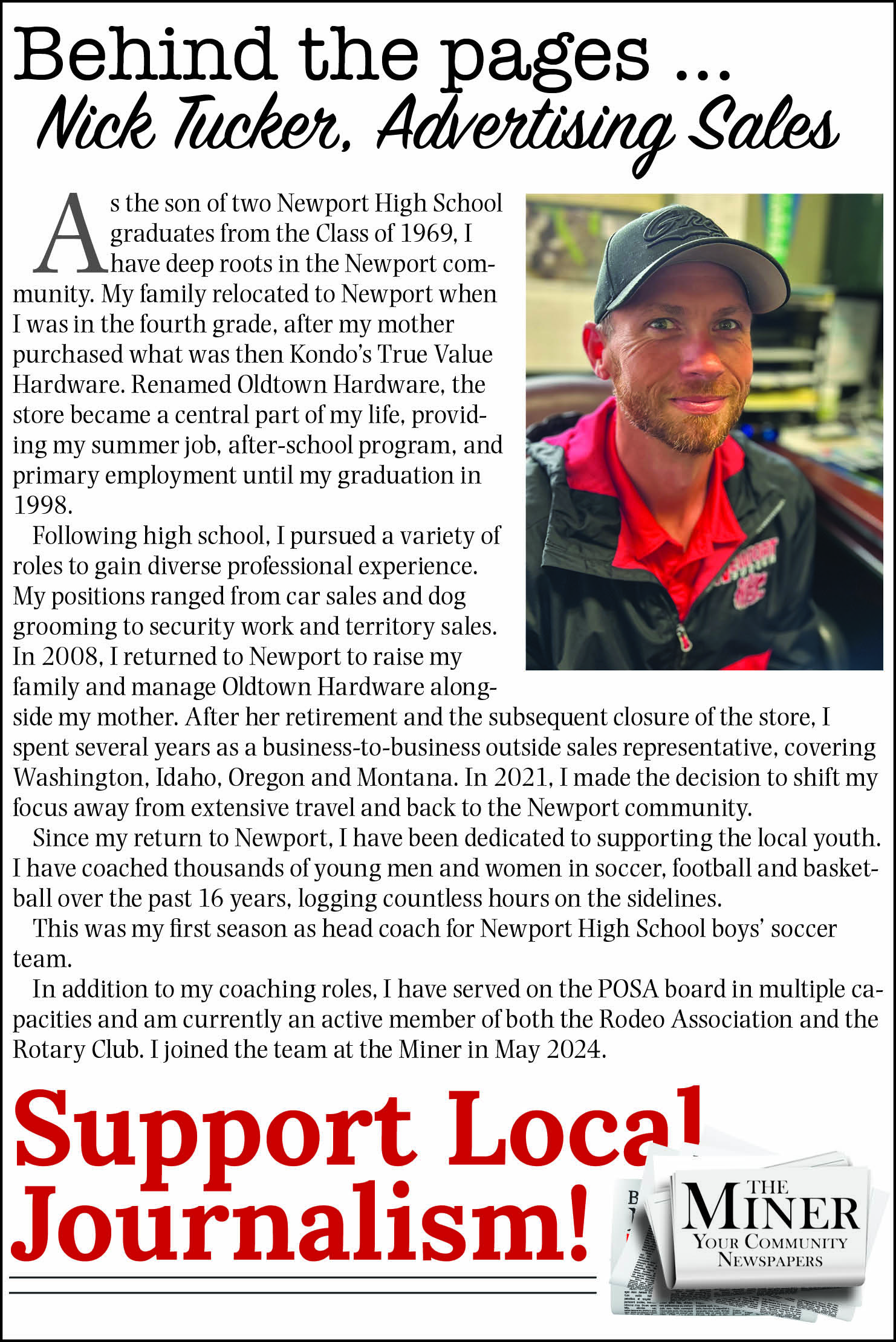
Nick Tucker, adoptee
Even before he found out he was adopted, Nick Tucker said he felt different.
“Like not necessarily 100% belonging in the adoptive family,” Tucker said.
He was 7, and Tucker said he lived the rest of his life wanting to search for members of his biological family, partly to learn their medical history.
Now 45, Tucker could not do so until his mid-30s after the state amended laws surrounding the release of information in closed adoptions, where adopted children do not have contact with their biological families. (They can in open adoptions.) Prior to that, the process would have cost Tucker thousands of dollars — money he said he did not have.
“To just kind of know that there was a family I came from, that there was that DNA, that biological aspect of it,” Tucker said. “It was just good to find out.”
He met his biological mother first. She had become pregnant with Tucker in Wyoming at 16 before moving to Spokane, where she gave birth and put him up for adoption via a private Catholic agency. Tucker’s adoptive parents, who were on a waitlist for seven years, then adopted him; they could not have another biological child for medical reasons.
“She was really easy to find,” Tucker said. “My biological dad, that took a little bit more.”
Through an Ancestry test, he traced his biological father back to Wyoming. He was around 17 when he got Tucker’s biological mother pregnant and did not know he had another son until Tucker contacted him, three years after Tucker met his biological mother.
“He was really open,” Tucker said. “I remember the first line in his message back to me said, ‘Well, it looks like my family just got bigger.’ So that was pretty cool.”
Though his biological father died in 2024 a couple years after he visited him in person, Tucker still keeps in touch with both sides of his biological family. He has four children, including a son of his ex-wife’s whom he adopted himself, and four stepchildren; right now, they are planning a get-together with his biological father’s side in Wyoming.
“It’s really cool how people are willing to step up and fill that need for a kid that they don’t necessarily have any responsibility for,” Tucker said of adoption.