.png)

THIS ARTICLE WAS PUBLISHED IN THE DEC. 4, 2025 EDITION OF THE INLANDER AND IS REPRINTED HERE WITH THEIR PERMISSION.
In the opening moments of Train Dreams — both the film and the Denis Johnson novella it’s based on — it’s 1917. In the ensuing years (mainly through the 1940s, plus a few scenes in the late ’60s) we follow protagonist Robert Grainier as he navigates the oft-unforgiving rural landscape as an itinerant laborer laying railroad tracks and felling ancient trees of the Northwest’s once-pristine forests.
Throughout the film, thanks to careful attention paid to set dressing, costumes, props and filming locations, many elements of the story are historically accurate. A few creative liberties, however, were taken with pieces of the timeline as is often the case in fiction, both on the screen and the page. It’s more so here that certain elements of the film were inspired by facets of real regional history.
So, with the insight of some local historians — Eastern Washington University history professor Larry Cebula and Pend Oreille County Museum and Historical Society researchers Sue Mauro and Rosalind Olsen — let’s break down how the film evoked the period of history in which it’s set.
Logging
While the title Train Dreams may have many watchers (or readers) expecting a story centered on the expansion of railroad networks throughout the American West, Robert Grainier actually spends more time beneath towering evergreens as part of a remote logging crew. For much of his stint as a timberman, the fictional Grainier and his counterparts felled trees with man-powered crosscut saws and axes, mainly using horses or gravity to move the massive logs. (A later scene in the film, probably in the mid- to late-1940s, shows the introduction of early chainsaws and use of other engine-powered machinery.)
Eastern history professor Cebula says the film does justice to the truly gritty — and often deadly — nature of logging during the era.
“I very much appreciated the historic texture of the logging camps,” he says. “The way the men lived, the reference to the tents being from the Civil War era, the muscle — all the work in the world was done with animal or human muscle, or wind and falling water, for almost all of human history, and this is the period all of that really starts to change with the steam engine being first applied to trains and then coming into the logging camps” to help move the timber.
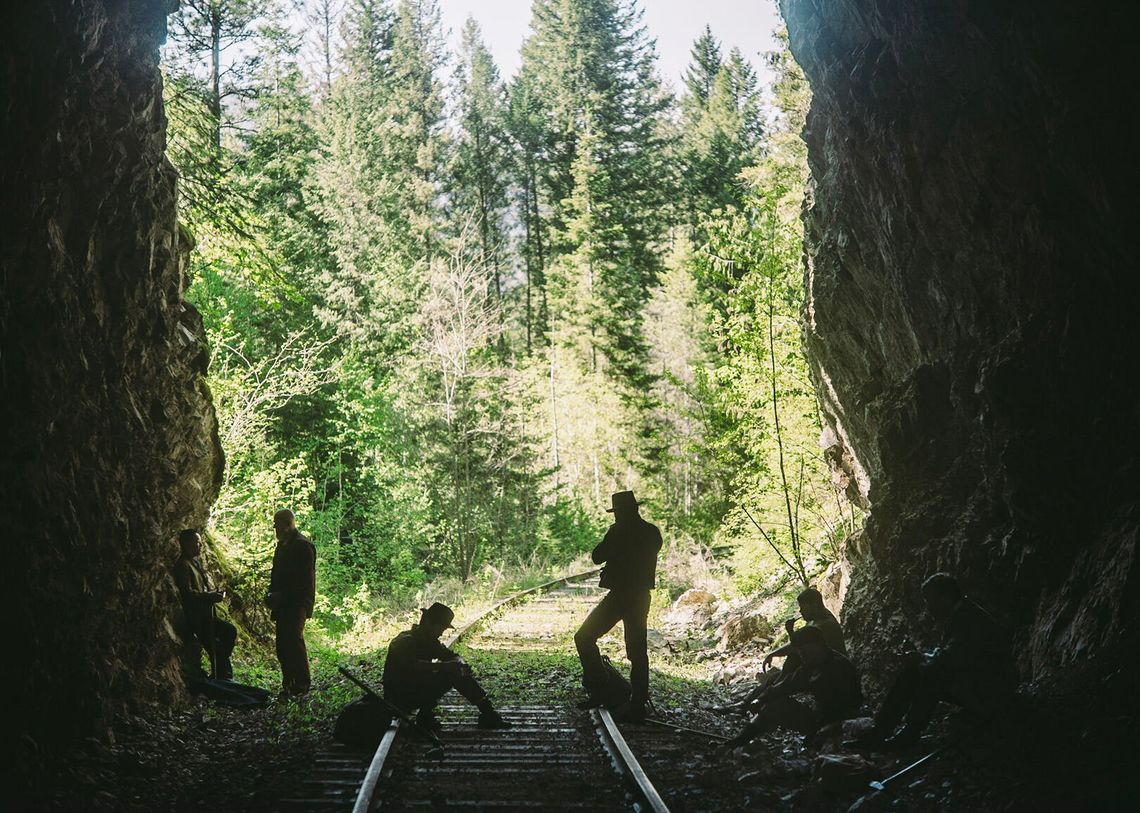
While Grainier travels around the region, including to Western Washington, for this seasonal work, it was also a major industry in Pend Oreille County on the eastern edge of Washington, not too far from where the film’s main story takes place, around Bonner’s Ferry, Idaho. (Denis Johson spent lots of time in his remote cabin outside Bonners Ferry.) Several scenes were also filmed in Pend Oreille County, including Metaline Falls.
“Loggers moved where the work was,” notes Sue Mauro, a curator at the Pend Oreille County Museum in Newport. “My grandfather was in Republic [and] Ione — they all moved to the work just like the main character.”
She also acknowledges how risky that work was.
“The logging deaths — that is true. When we researched in the local newspapers of the 1900s to 1920s, there were so many deaths and loss of limbs,” Mauro says. “It was a huge thing, and they were all risk-takers.”
Railroads
While Grainier gets more screen time in the logging camps than he does as part of a rail crew (plus several scenes of him riding trains around the region), there are still several moments depicting the laborious task of interconnecting the West’s cities and towns by rail. While the bulk of transcontinental railroads connecting the Eastern and Western U.S. were completed in the 1860s, regional lines were still being built into the first few decades of the 20th century.
“In Pend Oreille County, rail only came through in 1910,” Mauro notes, a point in time less than a decade before Train Dreams’ story opens in 1917.
In the film’s first half, Grainier is on a crew tasked with building a massive wooden trestle over a deep canyon, the completion of which shortens a rail route by 11 miles.
“Railroads were still expanding, or even overexpanding in this era,” Cebula says. “Lines were still being built, and a big example was the Milwaukee Road across Eastern Washington, which is now the Palouse to Cascades Trail.”
Forest fires
One pivotal moment of the film depicts a massive forest fire that tears across the landscape.
While raging wildfires have always been a scary reality of life in the densely forested Northwest, this particular moment of the story isn’t tied to one specific historical moment, although it does accurately draw on real events.
One of the biggest wildfires to impact the Inland Northwest in the early 20th century was the 1910 Big Burn, which charred 3 million acres across North Idaho, Western Montana and Eastern Washington. That mid-August firestorm was fanned by intense winds, resulting in the deaths of 87 people and the loss of entire towns.
“No one knew how to deal with them back in those days,” Cebula says. “You just got out of the way and hoped it rained.”
Later on in the film, Grainier transports a woman to a remote mountaintop fire lookout. After the Big Burn and preceding blazes, like the 1902 Yacolt Fire in Western Washington and Oregon, early fire detection efforts became a federal priority and fire lookouts were thus built on hundreds of peaks in the 1920s and ’30s.
For the fire lookout scenes in Train Dreams, Mauro says the Pend Oreille County Museum almost lent the crew a historical piece called an Osborne Firefinder, which was used to accurately pinpoint a fire’s origin.
“That was probably two or three years ago,” she says of when the museum was contacted about the artifact. “I helped them find one in Missoula [instead], but I looked really close in the scene of the lookout and didn’t see it.”
‘Loggers moved where the work was. My grandfather was in Republic [and] Ione — they all moved to the work just like the main character.’
Curator at the Pend Oreille County Museum in Newport Sue Mauro
Train Dreams main character Robert Grainier (Joel Edgerton) and his crew in a rail tunnel outside of Metaline Falls.