.png)

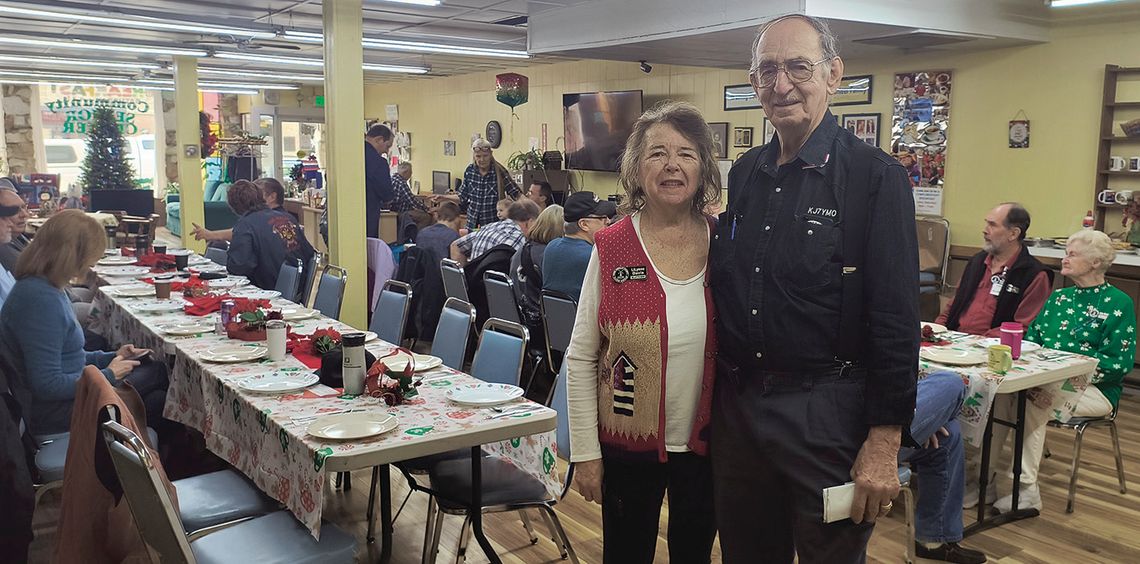
Jack Davis reflects on leadership and transition
On a Tuesday morning in Newport, coffee is poured, radios rest on tables and conversation comes first.
For Jack Davis, that scene captures much of what the Pend Oreille County Radio Group has come to represent during his time as president — a community built as much on people as on equipment.
“For a club like this, it’s not just about radios or call signs,” Davis said. “It’s about people showing up for one another and keeping things moving, even when conditions aren’t perfect.”
POCRG is a community- based emergency communications organization made up of 77 members supporting Amateur (Ham) Radio, General Mobile Radio Service, Family Radio Service and Multi Use Radio Service. The volunteer- run group works with neighbors, families, businesses and public agencies to provide alternative communication when traditional systems fail.
The organization is a registered 501(c)(3) nonprofit serving communities across northeastern Washington and northern Idaho.
A culture built on welcome
During Davis’s tenure, POCRG has experienced steady membership growth, largely driven by word of mouth and the club’s approachable, hands-on culture.
“I’ve never worked in an area that is so friendly,” Davis said. “We’ve developed camaraderie — working closely with fire departments, sheriff’s offices, Search and Rescue, CERT, ARES and the Native American community. We all work together as a community.”
That cooperative mindset extends beyond emergency response. Members regularly assist with training, preparedness efforts, and communication practice for partner organizations that depend on calm, reliable information under pressure.
Breakfast before radios
One of the most approachable entry points into the group happens weekly.
From 9 to 10 a.m. each Tuesday, members gather at the Hospitality House, 216 S. Washington Ave. in Newport, for breakfast and conversation. Radios are often present, but questions are encouraged before equipment.
“If you complain about the food,” members joke, “you probably get to cook next time.”
Much of what makes those mornings work happens behind the scenes, thanks in large part to Lilynne Davis, who helps coordinate food, welcome newcomers and keep things running smoothly.
“I try to load the car the night before,” she said. “Otherwise I don’t get the big coffee pot in.”
If no one has signed up to bring breakfast, she simply asks.
“We all help,” she said. “Everybody takes a turn.”
That shared responsibility has created an environment where newcomers feel comfortable asking questions — even the same ones more than once.
Learning by doing
POCRG emphasizes practical, hands-on learning. Members help one another program radios, install antennas and understand basic operating practices.
“A lot of it comes down to the basics,” Davis said. “How you hold your mic, how you set your radio, how you communicate clearly.
Etiquette matters.”
Regular practice is especially important for those supporting Search and Rescue, CERT, and ARES.
“The only way people get comfortable is by doing it,” Davis said. “You’re going to make mistakes.
That’s how you learn.”
A regional communications network
Under Davis’s leadership, POCRG has continued to support and maintain a network of repeaters designed to overcome the region’s mountainous terrain.
A high-level repeater on Cook’s Mountain provides coverage across most of Pend Oreille County, parts of Spokane County and large portions of Bonner and Kootenai counties in Idaho. Additional repeaters serve Cusick, Ione, Diamond Lake and surrounding areas.
A repeater installed in Cusick with support from the Kalispel Tribe expanded coverage between Newport and Ione, improving communications in areas that previously had limited reach.
Together, the system forms a layered communications network designed to function even when phone and internet service do not.
A year of transition
The past year also brought moments of reflection and transition.
Following the passing of Pat Molvik, who served as repeater trustee, the club addressed the need for continued oversight of its repeater systems. At a November meeting, members approved Shannon Mossman — a founder of POCRG, past director and two-time president — to serve as repeater trustee.
As 2025 draws to a close, POCRG has completed its annual election process, marking a smooth and easy transition toward 2026. New officers have stepped into their roles, with experienced leadership remaining available to support the organization as needed.
Will Welker is now president; Ernie Hood is vice president and Ray Barwell is treasurer.
For Davis, now the junior vice president, the transition reflects the strength of the group itself.
“When people care about the work and about each other, leadership changes don’t have to be disruptive,” he said. “The group keeps moving forward.”
An open invitation
While emergency preparedness remains a core focus, POCRG emphasizes that participation does not require a major commitment.
Families are welcome to stop in, ask questions and learn how radio communication can help parents stay connected with their children during everyday activities or emergencies — even if it’s just a single visit.
“We want people to feel comfortable,” Davis said. “There’s no pressure.”
As the year moves from Christmas into the New Year, Davis said the focus remains on what has always mattered most — people, preparation and connection.
In a rural county shaped by distance and terrain, the Pend Oreille County Radio Group continues to build something steady — one conversation, one connection and one shared signal at a time.