.png)

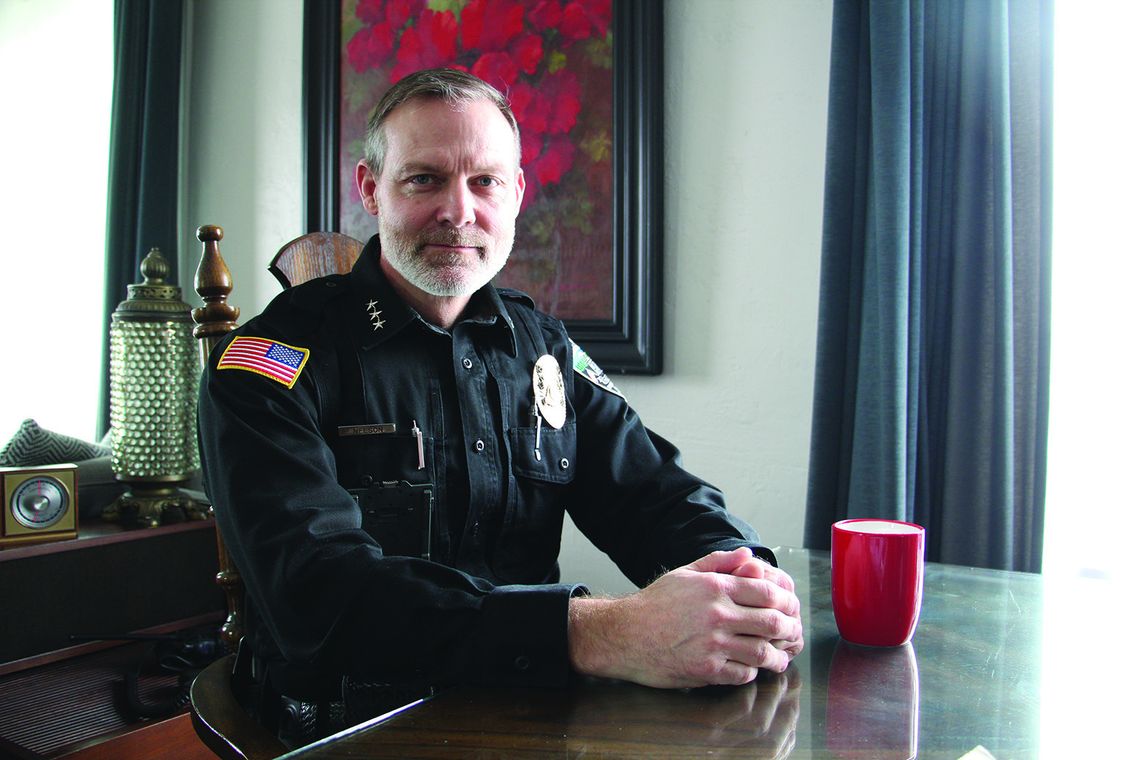
Q&A with city police department chief
NEWPORT — According to city police officers, crime has decreased across Newport.
Wade Nelson was hired as chief of the Newport Police Department about three years ago. Previously, he worked for the Spokane County Sheriff’s Office, gaining experience with civil matters, search and rescue, sex crimes, defensive tactics instruction and other areas of law enforcement.
“Crime is down,” Nelson said. “We still have little upticks of things here and there that happen, but on the whole, most of our crime is actually down. Our call for service load has gone down from the year before.”
Last Thursday, Feb. 19, Nelson sat with The Miner for a question- and-answer interview, which has been edited for clarity and length.
Question: What does NPD staffing and training currently look like?
Answer: “We’re actually fully staffed, which is great,” Nelson said. Besides himself, there are four NPD officers, including three patrol officers and one school resource officer. “The training we do either internally or we’ll go to seminars and things that go on around the city.” Police officers are required by the state to undergo a minimum of 24 hours of training a year on subjects like shooting, defensive tactics and community interaction. All NPD officers are in compliance with this training. “Every training we send them to costs money and our budget is small, so we try to save money.”
Q: A curfew was implemented after the malicious mischief crimes last summer. Has it been effective?
A: “The curfew hasn’t been in for a long time, but we have noticed we don’t have as many issues in the evening since it’s been implemented,” Nelson said. All Newport School District students and community members were informed of the curfew by NPD officers soon after it was passed unanimously by the Newport City Council. Before the curfew, NPD received more complaints about noise and other nighttime activity from minors. “We’ll know more once next summer rolls around.” Q: In response to complaints about pedestrian safety and speeding, NPD has made more traffic stops. Have those also been effective?
A: “We really didn’t start ramping that up until maybe July or August of last year,” Nelson said. “But I have noticed that people are driving slower. We haven’t had near the accidents in that time frame, and I haven’t gotten near as many complaints about people speeding.” Traffic stops are usually resolved with a verbal or written warning, followed by fines if necessary. Additionally, NPD has worked to reinstall speeding signs on Washington and Union Avenues. (Regarding pedestrian safety, Nelson advises pedestrians to enter the lane of travel while waiting for cars to stop, then to make eye contact with drivers while crossing.)
Q: Has NPD observed any trends in heroin or opioid use in the city?
A: “That’s a tough one, because usually we only get called if it’s overdoses. It ebbs and flows,” Nelson said. There are no heroin or opioid sellers in the city, but users of these drugs come and go, he notes.
No resources specifically for recovering drug users are currently available in Newport. “If someone’s taking that type of drug, they are definitely a threat to themselves or others, but it isn’t seen that way in our state — it’s a medical issue.” In Washington, felony drug possession only results in a misdemeanor. Moreover, Nelson said Narcan has changed user behavior, providing a pseudo-safety net for drug use despite failing to remove drugs from a user’s system.
“Seven cycles is what the average person has to go through to become clean, so there’s a lot of process there.”
Q: How is NPD incorporating or planning to incorporate new technology into its operations?
A: “We tried to incorporate a Flock Safety license plate reader system, but our council and everybody chose not to go that route,” Nelson said. He acknowledges the nationwide concerns about the controversial technology, but still advocates for it as a tool that can more quickly identify criminals, their vehicles and their whereabouts. “All of Spokane County has it. Other counties all over the nation are using it, so it ties all law enforcement into one system.” While NPD has access to body cameras, tasers and certain data processing systems, it has yet to use generative artificial intelligence. “To process our stuff faster, to make us more capable that way, is how we would like to use a lot of that AI stuff.” At NPD, AI could assist officers with report writing and evidence collection, giving them more time for field work. “A lot of places are doing it. Obviously, we don’t have lots of money, so what we can and can’t incorporate, I don’t know.”
Q: Has NPD observed any trends in city crime in general?
A: “Like I said, things ebb and flow here because we kind of know everybody in our town,” Nelson said. Most recently, NPD has dealt with an increase in car prowls, along with minor misdemeanors, property damage and theft. Domestic violence has also increased this winter. “We have our typical same type of crimes that’ll happen, they’re just different groups of people doing the same crime.”
Nelson urges city residents to report possible crimes not just on social media, but to NPD.