.png)

Local health officials warn about measles
NEWPORT — Unlike most, Dr. Leslie Waters still remembers the measles.
Waters was around 7 when she and her three siblings all caught measles at once. It was 1960 or 1961; at the time, her youngest sibling was a baby.
For more than a week, Waters and her siblings didn’t just experience the painful, full-body rashes most associated with measles, but also high fevers of around 105 degrees Fahrenheit, dehydration from vomiting and loss of appetite, light sensitivity and other extreme symptoms. Waters’ mother needed to take care of her children full-time until they recovered. They were lucky they weren’t hospitalized, Waters said.
“Measles, it makes you really sick and it’s extremely contagious,” said Waters, now 71 and a family physician representing Stevens County on the Public Health Advisory Board. “It is a miserable disease.”
She also still remembers when the vaccine was released, a couple years later in 1963. The vaccine was in such high demand that people formed lines around the block waiting to receive it. Many were parents, who wanted the vaccine for their children.
“There wasn’t a year when we didn’t miss school because we had some infectious disease,” Waters said. “So it was, when I think about it, really amazing when the vaccine came out.”
Yet despite being declared eliminated from the U.S. in 2000, measles has recently resurged across the county.
Since last year, cases have been confirmed in neighboring Bonner, Stevens, Spokane and Kootenai counties. According to the Centers for Disease Control and Prevention, 2,283 cases were confirmed in the U.S. in 2025 alone, marking the most cases since 1992.
While no such cases have been confirmed in Pend Oreille County, local health officials are warning residents to act in prevention of the spread. Waters believes the U.S. will soon lose its measles elimination status, which is currently under review.
“We are appropriately concerned about measles,” said Dr. Geoffrey Jones, a family doctor at Newport Hospital and Health Services and medical director of the Infection Control Committee.
Local health officials attribute measles’ recent resurgence to low vaccination and herd immunity rates, both of which have decreased in the years since the COVID-19 pandemic.
To prevent the spread of measles, a population needs at least a 95% immunity rate, as the risk for outbreaks increases even at 92%. In Pend Oreille County, as well as Stevens and Ferry counties, vaccination statuses are not meeting those standards. As of 2024, the last year with data available from the state Department of Health, as low as 49.9% of children ages 4–6 in Pend Oreille County were vaccinated for measles, mumps and rubella. Of children 19–35 months old, 63.3% are vaccinated.
“The disease hasn’t changed,” Waters said. “It’s just our resistance to it has changed now, because we’re not using the prevention that we have.”
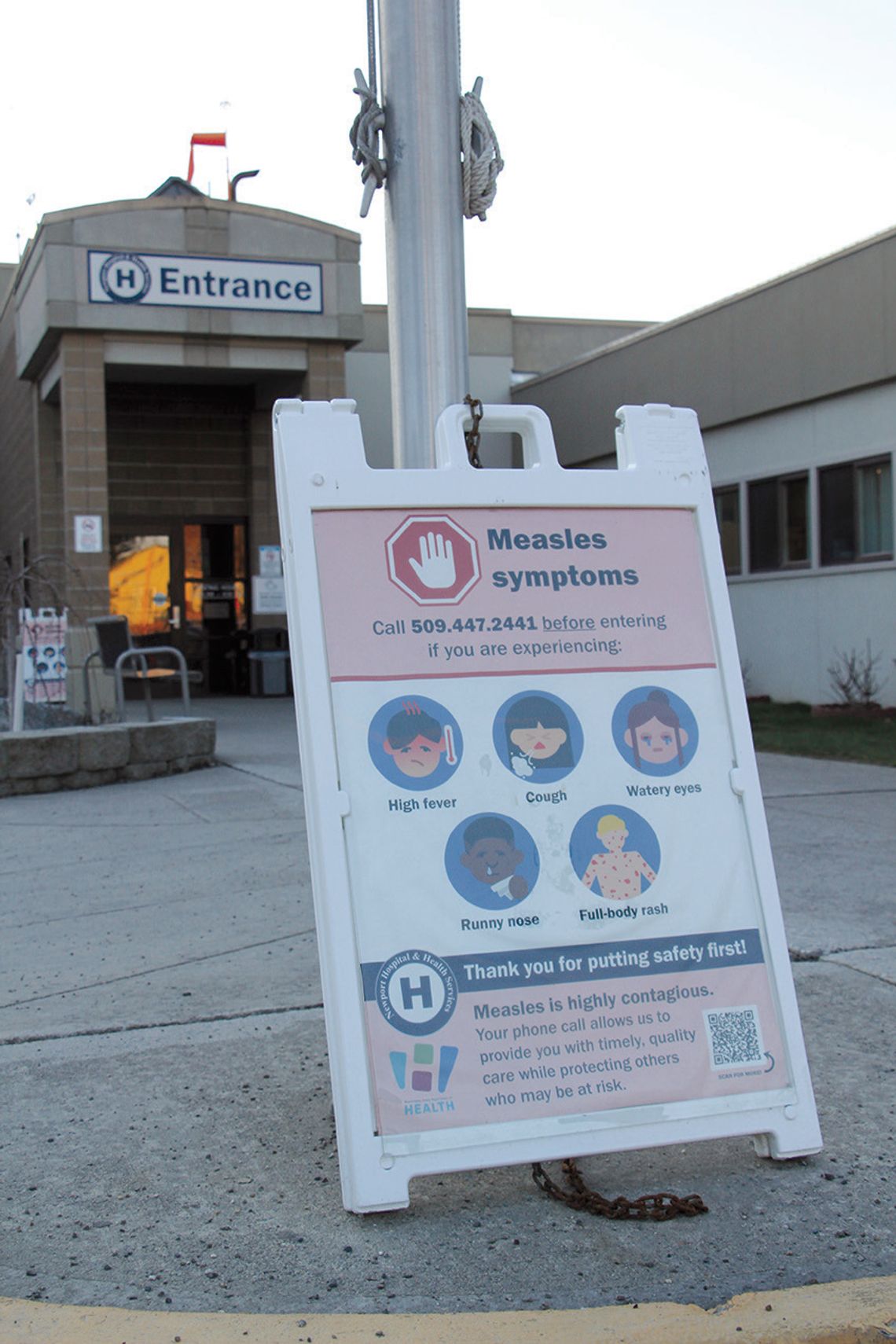
In addition to a rash, high fever and dehydration, measles can cause a cough, sore throat, runny nose and red or watery eyes. Moreover, measles is one of the most contagious diseases in the world; according to the state Department of Health, measles can remain in the air or on surfaces for up to two hours after exposure, and those who contract measles can spread it before showing symptoms.
Health officials use one marker, R0, to measure contagiousness among diseases, Jones said. The R0 of measles is 15, meaning that, in a susceptible population like Pend Oreille County, one case of measles can infect 15 other people. This is especially concerning in environments like clinics, where one person with measles can unknowingly expose an entire group of people to the disease.
“The chance that the other people, if they’re unvaccinated, are gonna catch it is pretty high,” said Dr. Samuel Artzis, health officer of the Northeast Tri County Health District. He is also on the Public Health Advisory Board.
Measles can even lead to other health complications, Waters said, such as pneumonia or ear infections that can cause hearing loss and in many cases deafness. One case in 1,000 results in encephalitis, a swelling of the brain that can cause seizures, hearing loss or permanent brain damage. One to two cases in 1,000 results in death.
Children under 2 who catch measles are more susceptible to developing subacute sclerosing panencephalitis, a rare disorder that progressively causes brain cell loss and ultimately results in death. There is no treatment for subacute sclerosing panencephalitis, which appears seven to 11 years after the children recover from measles.
“The real problem with measles is that it has a pretty high rate of complications,” Waters said.
Those who catch measles will experience symptoms one to three weeks after exposure, after which they should self-isolate from others. Meanwhile, those who know they were exposed to measles should maintain distance from the unvaccinated for at least three weeks.
“We’re still at risk for having spread in our communities,” Artzis said.
That risk is exacerbated by misinformation about vaccines, specifically measles vaccines, contributing to hesitancy surrounding vaccines in the U.S.
Two doses of the measles vaccine guarantee lifetime protection with about a 95% rate of effectiveness, Waters said. Besides side effects such as soreness at the vaccination site and, in one to 10 cases per one million, an anaphylactic reaction, the measles, mumps and rubella vaccine cause far fewer of the same complications as remaining unvaccinated. Waters and other local health officials emphasized that no dose of the measles causes autism, a common misconception originating from a now-retracted 1998 study.
“They were not able to confirm that MMR caused autism,” Artzis said. “And it’s pretty well evaluated and proven that it doesn’t cause autism.”
To prevent measles from spreading into Pend Oreille County, the Northeast Tri County Health District and Newport Hospital and Health Services have been collaborating with providers, schools, churches and other local agencies to raise awareness about the disease.
For more information on measles, local health officials don’t recommend referring to the U.S. Department of Health and Human Services, which Waters said has made incorrect reports and reduced vaccination requirements without evidential basis. Instead, they recommend the West Coast Health Alliance between Washington, Oregon, California and Hawaii, as well as one’s own doctor or physician.
“I really hate to have the present generation have to go through [the measles] again, in order to realize that the vaccine is important,” Waters said. “And that everybody should get it.”