.png)

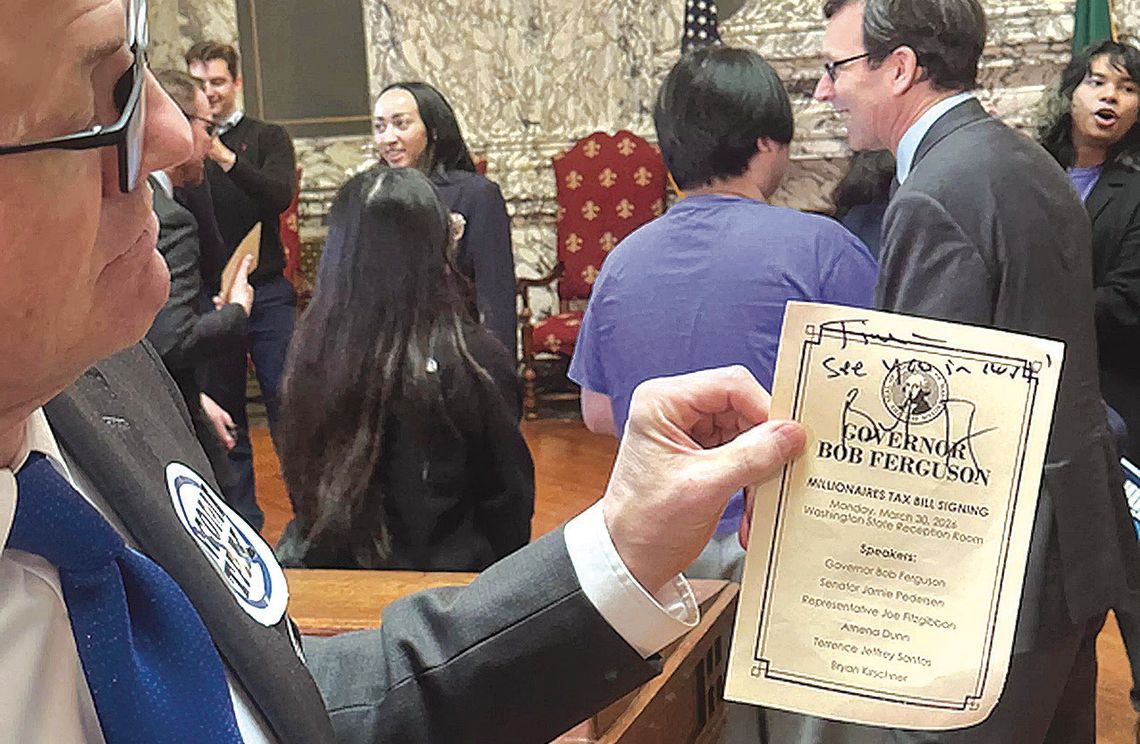
OLYMPIA – Gov. Bob Ferguson’s confidence that supporters of the new tax on incomes over $1 million will prevail – first in the Legislature and soon at the ballot box and in the court system – is perhaps best exemplified in a seven-word note he wrote shortly after signing the legislation Monday.
“Tim – See you in court! Bob Ferguson,” the governor wrote in a note he gave longtime anti-tax activist Tim Eyman after Eyman asked for an autograph following the governor’s signing of the income tax bill into law Monday.
As a sea of supporters celebrated inside the State Reception Room, Ferguson said the bill would go a long way toward equalizing the state’s tax code.
“It’s been a long journey to get here,” Ferguson said Monday morning. “But because of so many folks, it’s a historic day for Washingtonians.”
Washington is currently one of nine states without an income tax. The bill signed Monday imposes a 9.9% tax on income for joint filers or individuals with incomes above $1 million starting in 2029, with the money used to cut other kinds of taxes, as well as boost spending.
The tax is estimated to bring in around $3.5 billion each year when it takes effect.
“I’m proud to be here today to celebrate the most substantial progressive tax reform in our state’s history,” primary sponsor and Senate Majority Leader Jamie Pedersen, a Democrat from Seattle, said Monday. “A broad coalition of labor, business and progressive stakeholders came together to bring to life a reform that will make life better for everyone in our state.”
As he spoke, the governor again noted that less than 0.5% of residents would pay the tax, and said much of the revenue collected will help provide rebates and tax cuts. Ferguson said Monday that in the first year of the tax, “more than 40% of the revenue collected will go directly back to Washingtonians.”
Ferguson cited many of the provisions – including an expansion to the Working Families Tax Credit, universal free school meals for K-12 students, sales tax exemptions on diapers and over-the-counter medicine, and cuts to small business taxes – as key pieces of tax relief that got him to support the legislation.
The Working Families Tax Credit is a rebate for low-income families of $50 to $1,330 a year meant to reimburse them for sales taxes. The legislation would expand the credit to an additional 460,000 households each year.
Last year, about 350,000 families were eligible for the Working Families Tax Credit and 288,000 were granted the credit, which cost $208.2 million. The bill also calls for 5% of the money collected to be used for the Fair Start for Kids Account, which is used for childcare and early learning.
During the final days of the legislative session, state Sen. Marcus Riccelli, D-Spokane, pushed lawmakers to include funding for universal free school meals in the bill.
“In addition, of course, to sending money back to Washingtonians and small business owners, this bill will be making important investments, and that’s an understatement, into affordable health care, longterm care, quality K-12 education, all of the key programs that make Washington state great,” Ferguson said. “This is, truly, a historic step forward on rebalancing our tax code. It’s the right thing to do for Washington’s working families, it’s the right time to do it, and it’s the right policy.”
House Majority Leader Joe Fitzgibbon, D-West Seattle, said the legislation is “much more than a millionaire’s tax bill.”
“This is a tax reform bill,” Fitzgibbon said. “At a time when so many Washington families are struggling to make ends meet, we are going to make it a more affordable place to live, and a better place to work and to do business.”
Supporters are optimistic about what the tax will mean for the state.
Larry Delaney, president of the Washington Education Association, said in a statement Monday that the tax “will not only increase fairness for working Washingtonians, it will help meet our constitutional paramount duty to fund education.”
“This is truly a monumental win for kids, working families, and our state’s future,” Delaney said.
While Ferguson, Democratic lawmakers and supporters touted the tax’s benefits, conservatives in the state have argued the tax directly violates the state’s constitution, and have begun efforts to stop it.
Ahead of the bill signing, Senate Republican leadership urged the governor to veto the legislation, writing that the tax is “unconstitutional, unlawful, unpopular, unnecessary and unfair.”
“Today is a dark day in our state’s history. Republicans have said all along that an income tax on anyone in our state will become an income tax on everyone,” Senate Minority Leader John Braun, a Republican from Centralia, said in a statement.
In an interview following the session, state Sen. Mark Schoesler, R-Ritzville, said an overwhelming number of his constituents believe the tax will be expanded in the future.
“Nobody believes it’s just a millionaire’s tax. Call it a gateway drug, call it a foot in the door,” Schoesler said. “But my constituents overwhelmingly, people who don’t have a chance in heck of ever paying it, don’t believe it. They just don’t believe it’s gonna happen.”
State Sen. Shelly Short, R-Addy, said in recent years the state’s budget has grown with “no slowing.” As lawmakers look for more revenue in future years, she said they may look to lower the income threshold.
“That number’s going to come down,” Short said. “You just won’t get that deduction. With a simple majority vote, folks can change that in an instant.”
Brian Heywood, who founded Let’s Go Washington, announced Monday the organization had filed a referendum against the tax.
“We are filing this referendum to repeal Governor Ferguson’s unconstitutional income tax because unlike King Bob, we believe that the framers of our state’s constitution meant it when they wrote that ‘all political power is inherent in the people and governments derive their just powers from the consent of the governed,’ ” Heywood said in a statement.
Jackson Maynard, executive director of Citizens Action Defense Fund, announced Monday the firm is preparing a lawsuit against the tax, which will be filed “within days.” The law firm has retained former Attorney General Rob McKenna, a Republican who preceded Ferguson in the office, to lead the challenge.
Maynard said Monday he was not ready to discuss particulars of the case, including when it would be filed and in which court, though he said he’s “keeping all options open in how we handle this.”
Maynard noted that due to recent retirements, five seats on the state Supreme Court will appear on the ballot this fall instead of the typical three, which he said will give voters a chance “to have a say in the compensation of the majority of the court, which I think will be very interesting in relation to this case.”
“The income tax clearly violates the uniformity clause of the state constitution, and also the 1% cap that’s required,” Maynard said in an interview. “The state constitution defines income very broadly as anything tangible or intangible; there’s 100 years of precedent in that.”
Under this theory, opponents of the tax note that the state Supreme Court previously ruled that income is property. Therefore, they say, state laws on property tax would prevent an increase of the tax beyond 1%.
T.M. Sell, a Seattle-area author and former political science professor at Highline College, said in an interview Monday that a “potential flaw” in the argument put forward by Maynard and others is that other taxes in the state, such as property and business taxes, have thresholds.
“Below certain thresholds, you don’t have to pay the tax,” Sell said. “So there’s a precedent for doing that.”
The author of the 2023 book “Washington State Politics and Government,” Sell pointed to the current makeup of the state Supreme Court and solid Democratic majorities in each chamber as motivating factors for the tax to be passed this year.
“They’ve got such solid majorities in each chamber, they could take this on and throw somebody a bone if they needed to vote no so they can get re-elected,” Sell said.
Sell, who specializes in political economy and has written about how public policy impacts economic development, said it was doubtful the tax would impact the state’s business environment.
“If we simply adopted the tax system in use in that bluer than blue state of Idaho, we would be collecting something like 8 billion more dollars a year,” Sell said with sarcasm on Idaho’s political bent. “Idaho already has an income tax, and they’re a very conservative state.”