.png)

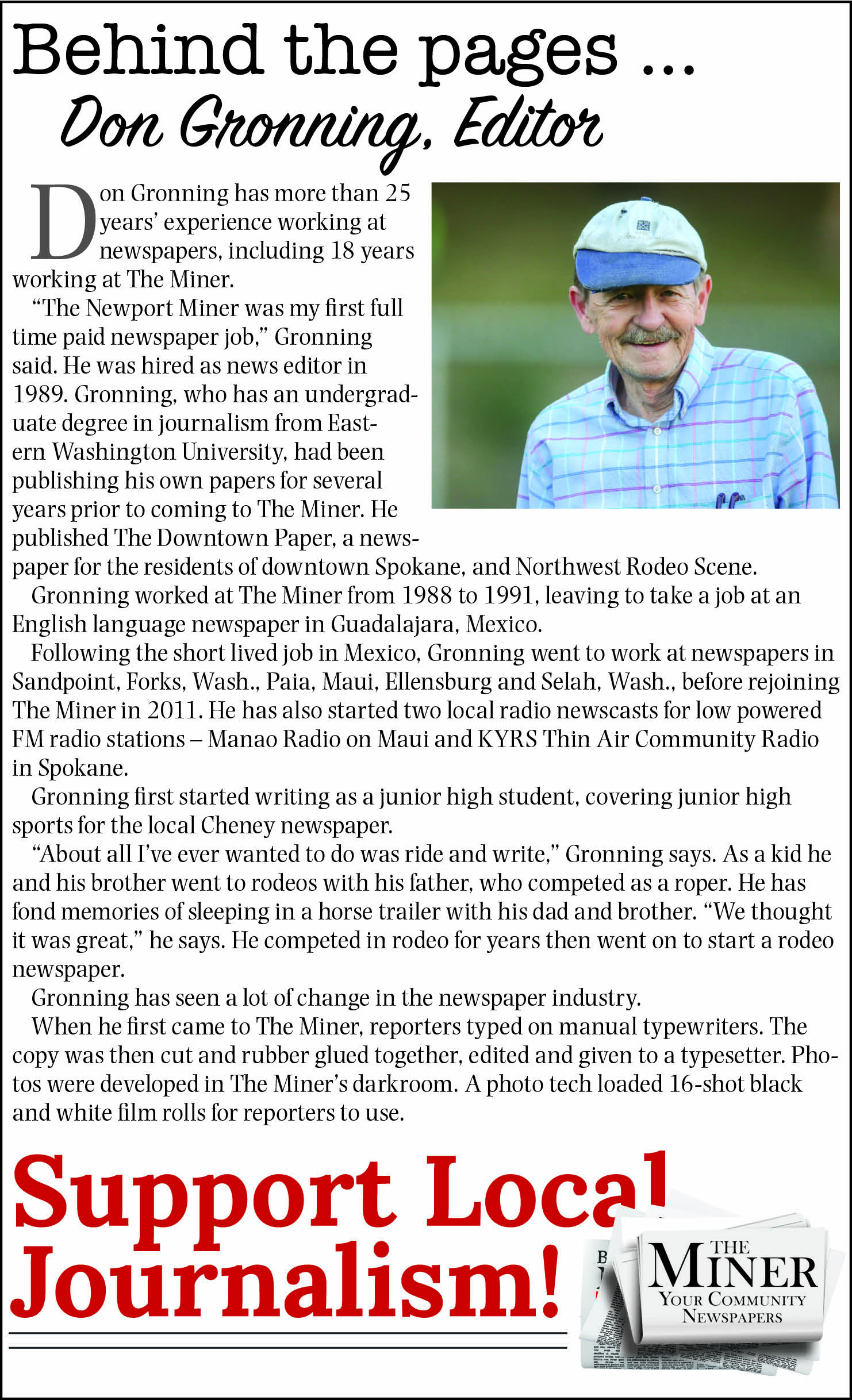
 Don Gronning
CUSICK — State Sen. Shelly Short, Rep. Andrew Engell and Rep. Hunter Abell talked about the recently concluded 60-day legislative session at the Camas Center in Cusick Monday night, March 30, and answered questions from a crowd of about 40 people.
The three 7th District legislators, all Republicans, discussed their role as a minority party in a Democrat-dominated legislature.
Rep. Andrew Engell, R-Colville, pointed out that most of the bills passed out of Olympia were not really partisan bills.
“There’s a lot of focus on how you run the government,” he said. “It takes work to run a government.”
But he said the minority party has a definite role in opposing things they don’t like.
“There’s two pieces to being a legislator in the minority party,” Engell said. “One is to make it harder for those in the majority to do their work.”
He said the minority Republicans look for “cracks in their ideas, so they can’t just be lazy and push really bad policy out.”
The Democrats have such a majority that most of the time they get their way, he said.
“But we’re trying to slow them down,” he said. Sometimes the Republicans have enough people show up and testify against policies that Democrats reconsider the idea because there could be political danger in pursuing it.
Sen. Shelly Short said that Democrats were able to pass an income tax bill on people with incomes of more than $1 million annually, but Republicans were able to stop what she called “initiative killer 2.0,” a bill that would have made it much harder for citizen initiatives to make legislation.
STATE:
Short said that a wildfire funding bill did make it through. The legislation started years ago as House Bill 1168.
Short said that was the bill that started putting funding into forest health, proscribed burns and prepositioning firefighting resources. She said a bill that was started last year allowed local fire districts to call up aircraft for help fighting fire. She said she’s happy the state Department of Natural Resources has money needed for that.
Homeowners insurance bills did not make it through the legislature, she said, but got a good start.
The crux of the homeowner’s insurance bills was requiring insurance companies to tell homeowners how they arrived at a rating for the homeowner’s property and giving homeowners and communities credit for making areas more fire-resistant.
Bill Deilke followed up on Short’s wildfire remarks.
“What can we do to put more heat and pressure on the insurance commissioner to get these state regulations,” Deilke said.
He was able to get wildfire insurance through the grange since he was a hobby farmer, but others could not do so.
He suggested tax credits and lower insurance rates for mitigation against wildfire.
Short said the bills were agency-sponsored bills introduced on behalf of the Insurance Commissioner.
The legislation was important to the commissioner but didn’t make it through the session.
There were things that homeowners, businesses and communities could do that should allow insurance companies to reduce their costs.
“If we’re reducing risks, that reduces their need for potentially paying out,” Short said. The insurance commissioner sees holes in the system. “That’s what those bills were designed to address.”
Rep. Hunter Abell R-Inchelium spoke about bills he successfully got signed into law.
He got a family burial ground bill passed allowing burials on family ground instead of a cemetery, a bill allowing electronic notarization of documents, a veterans’ bill that strengthens an advisory committee by adding representation from veterans’ service organizations and communities across Washington and a bill for the Port of Pend Oreille that allows workers to pay into one retirement fund instead of two.
Abell and the Republicans opposed the “millionaire’s tax,” which they described as an income tax and predicted it would be challenged in court.
They also opposed a “sheriff’s bill” that sets standards for elected sheriffs via the Criminal Justice Training Commission.
One man expressed concerns about the sheriff’s bill.
“I have a lot of angst about that,” the man said. “That non-elected folks can tell us who we elected can be decertified. I just have problems with that.”
Engell said he, Short and Abell share those concerns.
“It’s very offensive,” Engell said.
He said voters elected the sheriff, who is not only the chief law enforcement officer in the county, but also the chief executive officer in the county. The bill gives an unelected bureaucracy appointed by the governor the ability to remove the sheriff from office.
“That’s the crux of it, they’re putting restrictions on who can run also once they’re in office, they can be removed from office,” Engell said. “We believe it’s going to court.”
Abell said 90% of the members of the Criminal Justice Training Commission are appointed by the governor. “We should call a spade a spade,” Abel said. “It allows the governor to decertify a sheriff.”
Abell said the sheriff’s bill was a solution in search of a problem. He said voters could vote out an unqualified sheriff or have a recall.
Another man asked how to track bills and said he was blindsided by a bill that changed the insurance requirements on collector cars, vehicles 30 years old or older.
Prior to the law changing, when a person got a collector plate, they only had to provide proof of collector vehicle liability insurances once.
Now the vehicle must be insured like other vehicles.
Engell said that was a bad bill written for the insurance companies and targeting one unpopular Democratic legislator who had a collector car and used it for regular driving.
The man asked how he was supposed to know that was going on.
Engell said voters could call his office, as his staff knew what bills were in play. That wasn’t a perfect system, though, and that with so many bills in play, information could be lost.
Short said, as a floor leader, she was made aware of certain bills. But it really was hard, and legislators depended on staff.
The way it works now, the process is overwhelming. It is designed to be that way, she said, and that works against the deliberative process.
“It’s not deliberative anymore,” Short said. “It used to be you’d have work sessions on really big bills,” legislators discussing bills with experts.
“Now, it’s just we are going to have a bill hearing and you get two minutes to talk and they’re walking out the door.”
She said lawmaking should be difficult.
“Because laws that are passed in some fashion are going to impact people,” she said.
She said the public that was interested should look at certain issues and comment when they become aware of them.