.png)

 Don Gronning
‘Cutting edge, environmentally friendly’ computing research
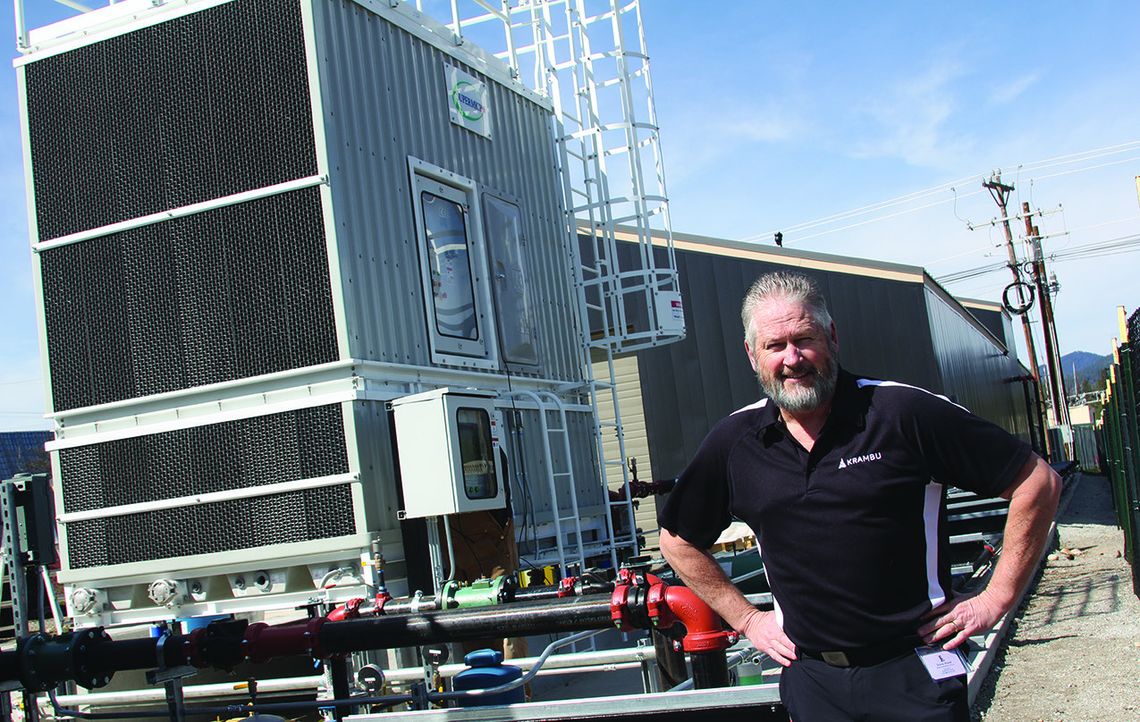
NEWPORT – For the last couple months construction crews have been bustling around the corner of Highway 2 and Union Avenue in Newport, working on a site owned by Krambu, Inc.
“We work on cutting edge, environmentally friendly and sustainable computing solutions,” Krambu founder and president Travis Jank said. Krambu has been operating the site since 2017. The Coeur d’Alene based company did some crypto mining but that wasn’t its main focus. The focus was on research and development to be used on large scale computing projects.
“In 2017 we developed some technology on the power and cooling side that was energy efficient and environmentally friendly,” Jank said. He said the technology allowed them to remove refrigerants and made the computers more energy efficient. “We got rid of waste.”
They were able to repurpose the heat from the computers. Steve Wood, former Ponderay Newsprint and Merkle Standard executive and now Krambu CEO, said the technology is the newest on the planet.
“We have been issued several patents,” Wood said, with additional patents filed.
“We partnered with Supermicro,” Wood said. Supermicro, Super Micro Computer, Inc., is a multibillion dollar global company that builds servers, storage systems and switches. Supermicro will be one of Krambu’s channel partners, he said, meaning they will help sell Krambu products.
The computers being built and located at the Newport site will be solving problems with Artificial Intelligence for clients, he said, using a computer network made up of 72 servers.
“These will be the highest performing computers in the world,” Wood said, using what is known as a 72-node cluster.
That many computers will require 1 megawatt of power to start, he said. Wood said Krambu is in negotiations with the Pend Oreille Public Utility District for the power. Krambu recently requested a service upgrade to the standard industrial category, PUD General Manager Chris Jones said.
The standard industrial category is made up of customers using ½ a megawatt to 2 megawatts of power, such as the Vaagen Brothers lumber mill in Usk. Merkle Standard, mostly known for its cryptocurrency production but increasingly moving to AI work, is the PUD’s only large industrial user, using 40-50 megawatts of electricity. Krambu won’t use anywhere near as much electricity as Merkle, Jones said.
Jank said the Newport site doesn’t consume an enormous amount of power.
“What other people would need 10 megawatts for, we can do with one,” he said.
Krambu may need more electricity as it grows, Wood said. He said electric use would probably be capped at 9.9 megawatts.
While Krambu will use electricity, it won’t use much water. The 72-node supercomputer is cooled with water, using a closed loop system, Jank said.
“Our target is net zero water consumption,” he said. He said the closed loop works sort of like a car’s radiator. Once it’s filled, barring a leak, no more water is needed. “There are a lot of data centers that burn an enormous amount of water to cool the computers.”
He said that is wasteful. “What we’re doing at this site is to prove that you don’t have to consume water to cool data centers or cool AI factories,” Jank said. “Water is a resource we value and the technologies we’ve developed are the most efficient technologies for cooling on the planet.”
Jank said about 500 gallons of water will be used to fill the closed loop system.
Wood said Krambu is spending more than $2 million on the Newport site, which is about an acre in size. The three lots run from Highway 2 to Pine Street.
“We purchased the pawn shop,” Wood said, referring to Newport Pawn.
While the computing research and development, the “proof of concept” work, is at the forefront of what Krambu does, Wood and Jank envision more than that for the Newport property.
“We think that these types of facilities should give back to the community,” Jank said.
Normally heat from the computers just gets sucked up into the air, he said.
“That energy that turns into heat is a valuable resource,” Jank said. Krambu’s technology allows the heat to be used for other things, such as greenhouses and aquaculture.
Wood said the plan is to have hydroponics and aquaponic production on site, growing fresh food and vegetables, as well as protein, such as fish.
“We plan to have a prototype greenhouse up and going by October,” he said. Growing fresh fruits and vegetables and raising fish using the heat generated by the computing is an example of the industrial symbiosis Wood talks about. He anticipates as many as a dozen full time employees working on the greenhouse. There are at least that many contractors working on the Krambu buildout now, including engineers.
Krambu is working on setting up computing operations at other sites, including one in Bonner, Montana, east of Missoula, using the technology perfected in Newport.
“We want to build AI factories,” Wood said.