Historic county theaters stay open despite struggles
NEWPORT — Almost every Main Street in small-town America has one.
Theaters have operated across the country since the 20th century, serving for decades as local businesses and venues for film showings, live performances and community news and events. The oldest theaters in Washington were established as early as the 1910s.
Yet today, theaters everywhere are being forced to close. Only around 80 historic theaters are left in Washington, three-quarters of which are in small or mid-sized towns, according to the Washington Trust for Historic Preservation, a state contractor that declared historic theaters endangered in 2021.
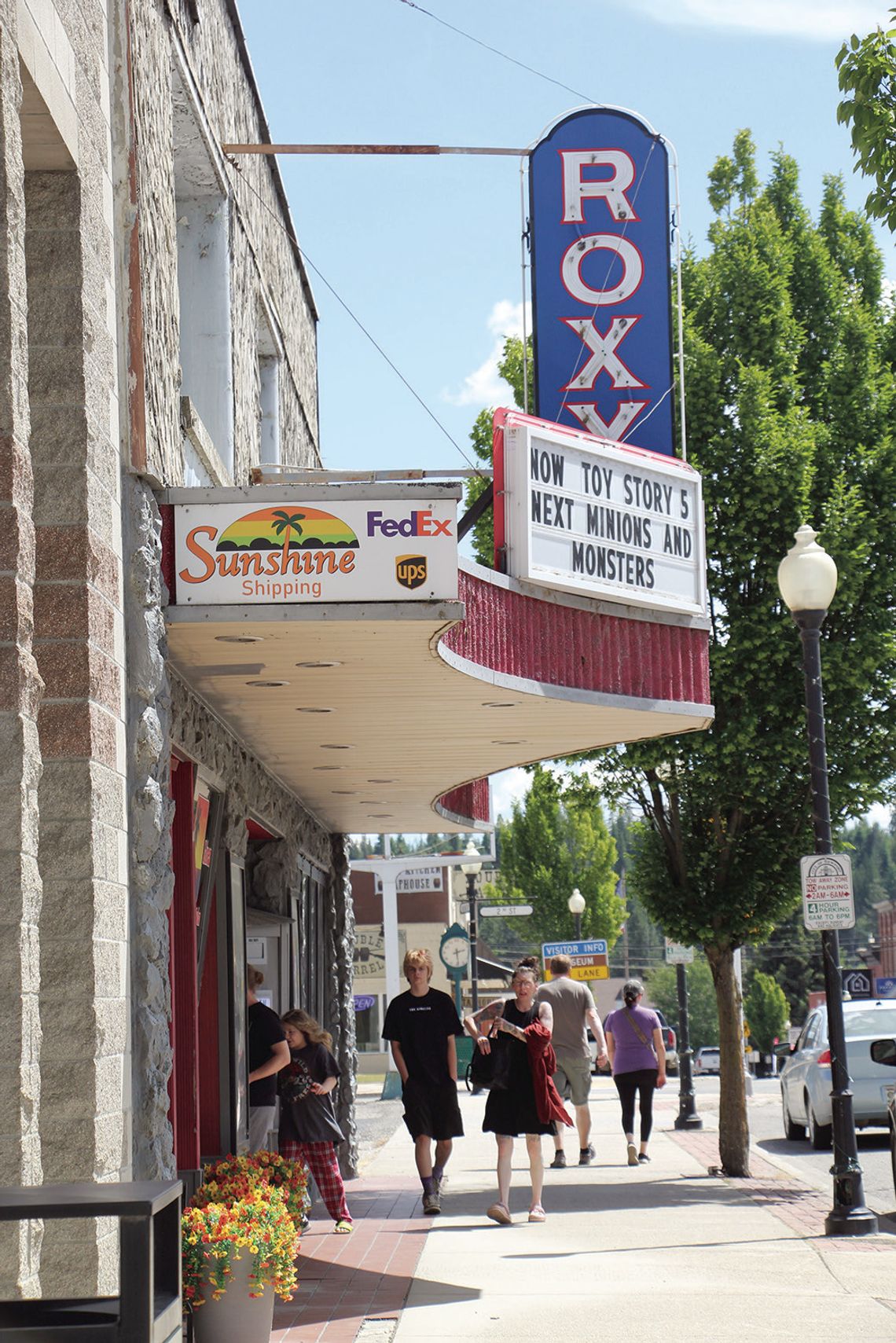
Pend Oreille County has two historic theaters: The Roxy Theater in Newport, built in 1951, and the Cutter Theatre in Metaline Falls, built as a school in 1912 and later converted to a performing arts center in the 1990s. Both are listed on the Washington Heritage Register, with the Cutter also listed on the National Register of Historic Places.
The NuVu Showhouse, another historic theater in Metaline Falls, announced a temporary closure last summer; Best Choice Realty listed the property for sale in June at $350,000.
“They’ve always been important through our history,” said Maddie Levesque, an architectural historian and general compliance manager with the state Department of Architecture and Historic Preservation. “And they continue to be important to this day to really express that economic and social vitality and cultural vitality of a local community.”
The Trust’s declaration came a year into the COVID-19 pandemic. Theaters experienced widespread challenges as lockdowns predicted to only last a couple weeks were instead extended to upwards of six months. Without any visitors, theaters lost thousands of dollars in revenue, leading many to lay off staff, defer capital improvements necessary for historic preservation and even close permanently.
“It’s tough to find funding for historic preservation,” Levesque said. “Especially for these types of projects — a lot of these theaters are privately owned.”
Results of an April 2021 survey conducted of 50 historic theaters in Washington reflected these trends. About 72% of theaters had been closed for the past year, according to the Trust. Owners reported a total of $3.2 million in losses — an average of $240,000 per theater — leading to an 83% reduction in staffing across all 50 theaters.
The Roxy closed for six months during the pandemic, co-owner Jason Totland said. He credits The Roxy’s subscribers with preventing a permanent closure; The Roxy had about 100 subscribers at the time, and none cancelled their subscription, enabling Totland and his co-owner/ wife Brittany to pay The Roxy’s staff, mortgage and bills. Additionally, The Roxy received seven COVID-19 relief grants from the state, totaling about $100,000.
While the Cutter did not close during the pandemic, it could not hold any events, Cutter executive director Stacy Pelkie said. The Cutter also received COVID-19 relief grants during that time.
“That made a huge impact,” Pelkie said of event restrictions. “We weren’t any different than anybody else.”
Moreover, theaters had been losing revenue for years before the pandemic.
The Roxy’s previous owners, Kevin and Cara Wright, bought the theater in 2007 as digital was in the process of taking over the film industry, Totland said. Only a few years later in 2010, film companies forced The Roxy and other theaters to transition from film to digital projectors, raised rental fees and required two-to-four-week contracts to rent first-run movies. These further increased expenses for The Roxy, which like other theaters already had less attendance since the 2000s, partially due to competition from streaming services.
Consequently, the Wrights remodeled The Roxy from a single-screen grand theater into a three-screen multi-theater. According to a 2022 DAHP report, there were many such urban development projects during the late-20th and early-21st centuries, in which historic places were either demolished or remodeled in ways that lead to their decline. The Roxy soon closed in 2015.
“Three screens make more sense in movie theaters — you have more content, people can come more,” Totland said. “But you’re also paying more for those movies, and those rooms were really small … And the community just didn’t accept them really well.”
The Totlands bought and reopened The Roxy in 2017, aiming to revitalize The Roxy and restore it back to a single-screen grand theater. In the years since, the Totlands have repaired building infrastructure, completed expansions and more, all culminating in a project started last year to consolidate the three screening rooms. As of today, Totland said the project is 95% done, aside from some carpeting and paintwork.
Still, Totland said both revenue and attendance have yet to return to pre-pandemic numbers. “We knew it wasn’t gonna be a moneymaker,” Totland said. “We kind of just have a heart for the community and we wanted to make it work.”
Though not originally a theater, the Cutter is a historic place that currently operates as one, making it eligible for historic theater grants from the DAHP.
The Cutter operated as the Metaline Falls School until it closed in 1971, Pelkie said. It was briefly repurposed for Selkirk School District offices and storage, then left to deteriorate until 1991, when administrators decided to demolish the building.
Local residents rallied together to not only buy the Cutter but restore it as a performing arts center containing a theater, library, museum, gallery, daycare and other community resources, Cutter Board President Erin Kinney said. With grant funding, donations from residents and tens of thousands of hours of volunteer labor, the Cutter reopened, now run by a non-profit organization of the same name.
The Cutter also shares The Roxy and other historic theaters’ need for capital improvements. There are plans to replace the front door and windows, the latter with more energy-efficient versions, Kinney said. Previous projects involved the reinstallation of the roof and chimneys, as well as carpet and flooring in certain parts of the Cutter.
“This is a building that keeps on giving us project after project after project,” Pelkie said. “There’s always something to be done, so we’re always needing financial help to keep this building up and running.”
However, small towns often do not have the financial means to support projects at historic theaters, which can cost hundreds of thousands, if not millions, of dollars.
According to DAHP, historic theaters located in small towns and rural areas tend to have poorer market conditions and fewer wealthy donors for capital improvement fundraisers like those frequently held by The Roxy and Cutter. Moreover, historic preservation advocacy may not have as much of a presence in small towns and rural areas.
To address this, the state Legislature approved in 2021 the establishment of DAHP’s Historic Theater Capital Grants Program, managed under contract by the Trust. A total of $515,000 was appropriated in the 2025–2027 state budget for the program, described to fund capital improvement projects that restore and rehabilitate historic theaters.
The Roxy received a $34,000 grant from DAHP last year to fund part of the remodel, matched by $70,000 from the Totlands, Totland said.
“We were seeing complete roof collapses that needed to be replaced and a lot of HVAC systems. There were seating needs,” said DAHP’s Levesque, who heads the program. “With those, there’s also some more cosmetic things that bring the theater to life.”
Grants are not the only reason The Roxy and Cutter are still open, though.
When the Totlands bought The Roxy, they introduced a technology-driven business model to the theater, said Totland, who works as a service delivery manager. Included in that were the aforementioned subscriptions, as well as The Roxy’s website, which doubles as an independent ticketing platform, and a database of ticket and concession sales, which the Totlands use to select more profitable movies.
Recently, The Roxy has focused on acting as an event space, hosting live comedy and magic shows and rental events such as birthday parties. These provide The Roxy with an alternative source of revenue; movies break even, Totland said, but events create profit. The Totlands’ staff has also shrunk to four to five employees, reducing administrative costs.
Most importantly, The Roxy and Cutter continue to see community involvement and support — both of which allow theaters to overcome barriers to historic preservation like cost, according to DAHP.
“The Roxy is at the mercy of the community — the community supports The Roxy, they keep it alive,” Totland said. “As long as people keep doing birthday parties here, keep coming to movies, support live events, we have a future.”
In turn, the Totlands and Cutter members are working to ensure their buildings have a future.
Besides residing in its original building, The Roxy has retained most of its original appearance, said Totland, who worked there as a teenager. The sole exception is the concessions area; that area used to only fit a couple employees at most, so it was expanded mid-century modern style. The Totlands have also collaborated with and received funding from the Washington State Historical Society, which approved remodel materials and plans and confirmed they were historically accurate.
At the Cutter, the decor on the main floor was restored to closely resemble 1912 decor, an effort reflected on other floors as well, according to the Washington Heritage Bulletin. Historical features on the Cutter facade were cleaned and repaired, and original blueprints were followed when installing the roof and chimneys.
“It’s got the history; it’s got the culture. When you walk into the building, it’s very nostalgic — people walk in here and are like, ‘Wow, I can’t believe this building looks like this,’” Pelkie said. “And I think that today, people have lost the appreciation of things like that.”
The NuVu Showhouse could not be reached for comment.