.png)

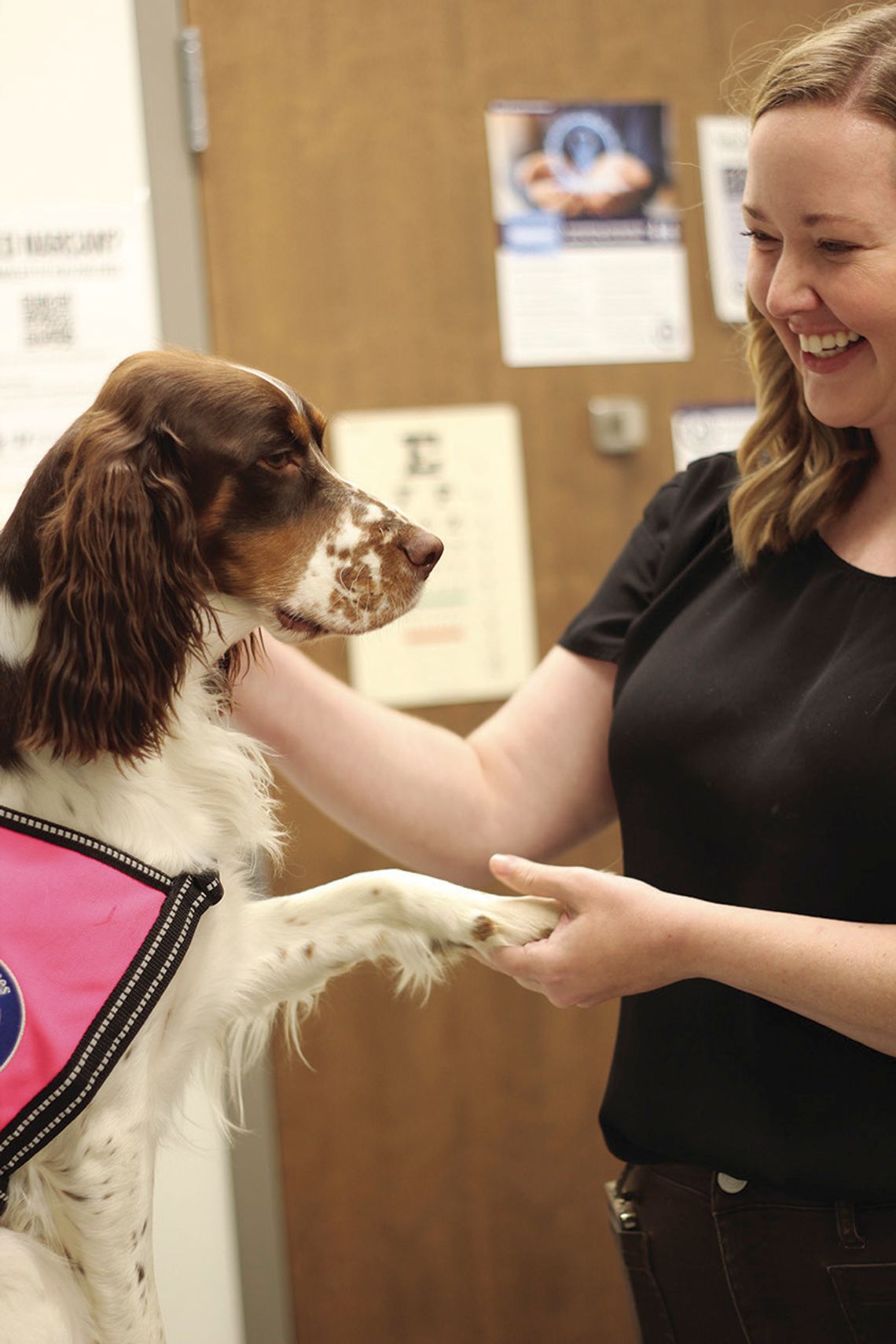
NEWPORT — Newport Hospital and Health Services’ newest staff member has two distinct characteristics, a white coat with brown spots and flecks and a certain preference for beef liver- flavored treats.
Clara is a certified therapy dog and service animal owned and handled by Dr. Taylor Stewart, a full spectrum family medicine doctor and clinic medical director at NHHS. Still only 14 months old, the springer spaniel has been serving NHHS since April and is trained to assist patients in a variety of settings and situations.
“I think there is a broader need to bridge the disconnect between patient and medical care,” Stewart said. “Animals are a really natural way for us to express our emotions, but also to have something to bond over.”
As a therapy dog, Clara approaches patients with the naturally friendly demeanor that is a distinguishing trait of her breed, greeting and initiating contact with them.
During vaccinations or examinations, she sits with children and play-acts ear, heart rate and other routine checks, calming their nerves by showing them the processes beforehand. At the hospital, she enjoys visiting inpatients, offering them pets, laying with them in bed or accompanying them on wheelchair rides. Clara even comforts patients’ loved ones, regardless of whether they are patients themselves.
Clara is in therapy mode most of the time, Stewart said, but sometimes she enters service mode in response to acute anxiety, panic or other emergencies. She was trained in deep pressure therapy, meaning she treats patients by acting as a weighted blanket while they destress.
“When she is in service mode, she really is locked in and she’s only with that person and she’s not doing any other things,” Stewart said. “And so, she does a really good job of switching.”
A lifelong dog owner, Stewart was searching for a new dog to keep her 10-year-old labrador company. Having owned two springer spaniels be- fore, Stewart knew she liked the breed, and acquired Clara just outside Sandpoint.
When she was around 4 months old, Stewart started bringing Clara to the NHHS clinic after hours, just to introduce Clara to her coworkers.
“Really, you could tell that she was calm here, even as a puppy,” Stewart said. “She loved when staff would pet her or hold her. She always wanted to greet people and be held and be happy with them.”
After a few weeks of seeing Clara interact with her coworkers, Stewart realized Clara had the potential to become a certified therapy dog. So, she decided to try putting Clara through training.
Service animals have the additional right of public access, Stewart said. With that, Clara had to prove that she could be polite, stay in an area, come when called and not pick up objects unsolicited — in other words, that she could enter busy environments full of distractions and remain attentive to patients. Meanwhile, Stewart had to prove that, as her handler, she could communicate with and control Clara.
“She was not a hard dog to train. As soon as she realizes what you want her to do, she’ll do it,” Stewart said, adding that springer spaniels are known for their intelligence and trainability.
Animals have a proven ability to improve human health, Stewart said.
In terms of mental health, studies show that patients with pets are more likely to continuously attend appointments, more likely to remain in a safe environment, less likely to require escalation of psychiatric care and less likely to self-harm, Stewart said. Even animals without Clara’s training can provide mentally ill patients with emotional support, making them more likely to adhere to treatment.
One study shows that patients who undergo cardiac surgery post-heart attack are more likely to fully recover if they have a pet, Stewart said.
Some patients schedule their regular appointments at NHHS to coincide with Clara’s on-days.
“It just helps in the hospital environment for someone who is stuck there, maybe for a few days and they’re sick, to be able to be like, ‘OK, I get to have a visit from a dog,’” Stewart said. “‘I get to have this normalcy.’” Patients are not the only ones who benefit from Clara’s employment. Besides during individual patient visits, Stewart has observed an increase in morale and satisfaction among NHHS staff.
Clara enjoys making the rounds on NHHS’s campus, Stewart said, visiting staff at each department. A sign in the Newport Health Center’s central desk area indicates Clara’s location to staff at all times, including when she is busy playing with another coworker’s pet dog. On display next to the sign are two framed photos of Clara, one of which is printed on her work badge. Also in the area is Clara’s bed and a bone-shaped sign reading “Doctor Clara” gifted by staff.
“She hasn’t been here that long for her current level of popularity,” Stewart said.
Clara works at the hospital at least once a week. When Stewart is on call every five to six weeks, Clara comes too, usually for seven half-days in a row. As she matures out of puppyhood and gains more experience, Clara will become capable of working at the hospital more often and for longer periods of time, Stewart said.
Stewart expects that Clara will serve as NHHS’s certified therapy dog for the foreseeable future.
“It was a new concept for us to be able to do this, but something that we were excited about seeing if it would work,” said Jenny Smith, public information officer at NHHS. “[Clara is] pretty special.”