.png)

EDITOR’S NOTE: Republished from the Spokesman-Review ‘s Aug. 17 edition.
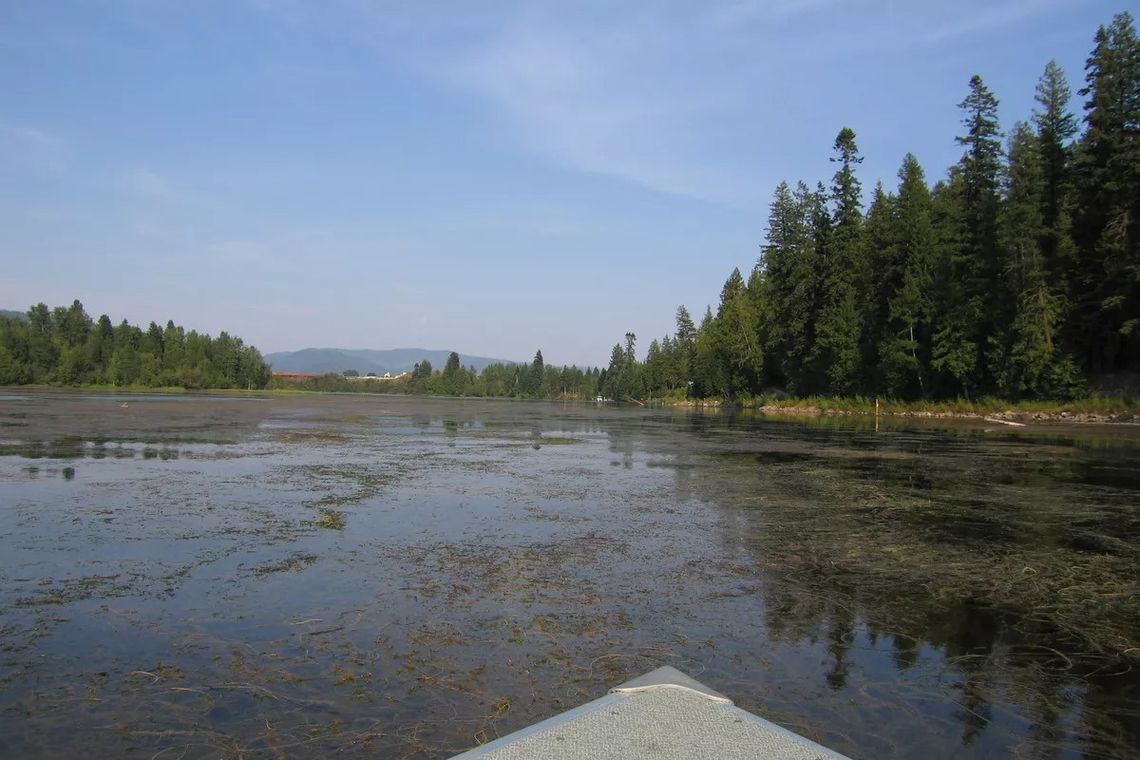
Along the surface of many lakes, golf course ponds and rivers in Washington is a thick mat of deceivingly strong weeds.
Known as watermilfoil, the plant is a nuisance for boaters, anglers and property owners who dread getting their propellers stuck in the featherlike leaves. Its rapid growth blocks out sunlight and kills off native aquatic plants that fish and other species depend upon for survival.
Shawn Ultican, an aquatic pesticide permitting specialist with the Department of Ecology’s Water Quality Program, said some native types of milfoil form an important part of aquatic ecosystems, but the invasive species, such as Eurasian milfoil and variable leaf milfoil, disrupt natural environments in numerous ways.
“They tend to grow pretty aggressively, much more so than the native plants, and then they can clog up swimming areas,” Ultican said.
Invasive watermilfoil tends to grow closer to shore and in shallow water where they have access to sunlight. They also have negative impacts on the level of dissolved oxygen in the water.
“They can cause the water to be more stagnant and to warm up more,” Ultican said. “Warmer water carries less oxygen than colder water.”
Without enough dissolved oxygen in the water, plant and animal species can die off and algae blooms can proliferate and turn lakes into an unhealthy and unsavory shade of green. Given that invasive milfoil blocks out sunlight, ruins recreational opportunities, and outcompetes native aquatic plants, there’s a strong desire among regular people who live next to waterways and government entities to eradicate the plant.
Thurman Johnson, a noxious weed and stewardship specialist with Spokane County’s Noxious Weed Control Board, said the Eurasian milfoil is so ubiquitous, it’s nearly impossible to get rid of.
“We do not currently conduct any treatments for Eurasian watermilfoil,” Johnson said. “So, our role, as it pertains to Eurasian watermilfoil and any nonregulated noxious weeds, is purely advisory and supportive. People can come to us and ask us for assistance in identifying that plant and differentiating it from the native watermilfoil.”
Watermilfoils primarily reproduce through a process known as fragmentation. Even the most miniscule piece separated from the rest of a plant can float, sink to the bottom of a waterway, and rapidly grow roots to form a new colony. This means that certain methods of removal, like sending divers down to pull out the weed, are largely ineffective.
Johnson said that some sort of screen or fine netting could be used to pick up the little pieces, but only in select cases.
“That’s why people tend to use a chemical herbicide to control it,” Ultican said. “Fortunately, the chemical herbicides have evolved over the years, and there are some products now that are really specific to milfoils and have a very low risk of harming other aquatic plants when they’re used.”
More recently, Johnson said there’s been growing interest in a chemical known as florpyrauxifen- benzyl.
That chemical is a systemic herbicide, meaning it’s absorbed through leaves or roots and travels through the plant to kill the entire organism.
Florpyrauxifen-benzyl is also selective for milfoil, won’t harm most of the native aquatic plants in a given area and requires less application then most other herbicides.
Since government entities, like the Spokane County Noxious Weed Control Board and the Department of Ecology, rarely do their own treatment for milfoil, it’s up to businesses, like AquaTechnex, to do that work.
Terry McNabb, the owner of AquaTechnex since 1972, said ProcellaCOR is their primary tool for fighting milfoil.
And the main ingredient within ProcellaCOR is florpyrauxifen-benzyl.
“Dissolved oxygen and temperature inside these (weed) beds is degraded significantly,” McNabb said via email. “The Columbia River is heavily impacted by this invasive plant in this manner and salmon are impacted.”
“Water temperatures inside these weed beds can be 20 degrees warmer than the main channel,” he continued.
“And at levels fatal to young salmon, they end up concentrated on the outside edge of the plant beds where they are susceptible to significant predation as they migrate to the ocean. These beds are also a threat to swimmers. There are a number of drowning deaths each year as people become tangled.”
McNabb said Procella-COR is applied under a permit from the Washington Department of Ecology or the Idaho State Department of Agriculture.
North of Spokane, Lyndsie Halcro with the Pend Oreille County Noxious Weed Board, said milfoil has spread through the river so fast that they “don’t have the means to fight it.”
They do, however, offer equipment rentals and send invoices to licensed pesticide appliers who want to use the permit they have – which costs about $500 a year – through the Department of Ecology.
Johnson said numerous herbicide options other than ProcellaCOR can control watermilfoil. One chemical – 2,4-D – is still used frequently, as is an aquatic formulation of triclopyr, which is a treatment primarily used to target woody and broadleaf plants.
Since government agencies have largely taken a hands-off approach to combating milfoil, it’s often up to lake groups and residents to deal with the invasive plant.
“Waterfront property owners are concerned about whether their beach is safe for their children or grandchildren to swim,” Ultican said. “They’re concerned about entanglement.
They are concerned about recreational access, watercraft, or being able to use the area around their docks. So I think it could have an impact on property values because of that perception.”