.png)

Two local musicians play for renowned Spokane Symphony
NEWPORT — They bring the power of music to life.
That is the mission of the Spokane Symphony, the largest and most dynamic professional performing arts organization in the Inland Northwest — a mission that involves two locals from Pend Oreille County.
Steve Munson, one of only two music teachers at the Newport School District, and Scott Rednour, a former Usk area resident who teaches in Eastern Washington University’s music department, both play for the Symphony as on-call musicians.
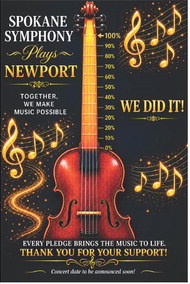
As of Monday, Sept. 7, a group of community partners has raised $25,000 to host the Symphony in Newport for a free concert, scheduled spring 2027. They welcome additional support for use as seed money in hosting the Symphony again, via newportcreativedistrict. com/spokane-symphony- plays-newport. While they organize the Symphony’s visit to Pend Oreille County, here are Munson and Rednour’s stories.
Steve Munson
From band and choir lessons to school concerts, Munson is always sharing music.
Munson, 34, is the band and choir director at Sadie Halstead Middle and Newport High Schools. He has taught band and choir here for around three years, and under his tutelage, dozens of Newport students have performed in regional honor bands and choirs. Munson himself has played alongside groups like the Symphony and Coeur d’Alene Summer Theatre. “Mostly I enjoy making music, whether that’s by myself or with my wife or at church or my students or with Symphony,” Munson said. “It’s something that you do together.”
Raised in Montana and Idaho, Munson got into music at a young age. He learned how to play the piano from his mother, a piano teacher. His father was a substitute music teacher and piano tuner, leading the music at their family’s church.
“I always had music at home,” Munson said.
With piano as his starter instrument, Munson soon learned how to play cello and the French horn, joining band in high school. He also continued to sing for choirs, a passion that began in elementary school and lasted through middle school, high school and college.
Munson remembers hearing the French horn for the first time in elementary school from some upperclassmen. He loved the sound, but because he and his family moved, Munson did not get to play the instrument until eighth grade, when his school principal’s wife let him borrow her French horn for after-school practice.
“It was very difficult, I think in some ways a lot more difficult than cello,” Munson said of the French horn. It took him almost two years to gain the confidence to play it without any piano accompaniment. “But I loved it, and I stuck with it.”
Munson set aside cello in pursuit of the French horn, improving enough in high school to play with the Coeur d’Alene and Spokane Youth Orchestras. It was at this time that Munson became more invested in music, he said, eventually deciding to study the French horn at Whitworth University for his bachelor’s and Indiana University for his master’s.

Munson

Rednour
He was only in college when he auditioned for the Symphony with the French horn and made the sublist — a feat he describes as a significant move in his career, and an opportunity only one or two college students receive in any given year.
“I had also had a bunch of unsuccessful auditions for various music festivals geared towards young musicians, orchestral musicians,” Munson said. “And most of those I did not get into.”
He emphasizes the importance of practicing, as well as not giving up, acknowledging support he received from his own parents, teachers and directors. Jennifer Brummett, a Whitworth educator and the Symphony’s principal horn player for a time, encouraged Munson to audition for roles, work hard and excel as a musician.
“So, the good instruction and the persistence,” Munson said. After earning his master’s and marrying his wife in Indiana, Munson would return to Whitworth years later for his teaching certificate.
He cites a number of reasons for his shift from performance to education. For one, Munson always enjoyed sharing what he learned about music and other subjects with his peers. During graduate school, Munson competed with musicians who appeared better and more motivated than him at performance, an experience that made him question his career path. Munson was also concerned that a career in performance would require him to live in a big city, despite having only lived in mid-sized towns.
“It was never my first plan,” Munson said of education. “But I’m certainly grateful that’s where I am and that’s what I’m doing.”
Munson taught K-12 music in Rosalia for about five years before landing a job in Newport. He encourages all to attend the free concert, as live classical music is powerful and moving — so much so that it inspires many to pursue music themselves.
“Expect to see ordinary, everyday people who are exceptional professional musicians, sharing that with us and our community,” Munson said of the Symphony.
Scott Rednour
To Rednour, a composition of music is a work of art.
When the 67-year-old pianist sits down to practice, to hone a piece for performance readiness, he views it as part of his duty to honor the composer’s work. A way to pay respects, from one artist to another.
“There is probably no one day when I wasn’t inspired by either the music or the composer or what it means to be a performing musician,” Rednour said.
That inspiration came early to Rednour, who was born in Newport and raised in the Usk area. His mother played piano and organ for their family’s church, so from a young age, Rednour often sang and played music with her and his siblings. He took his first piano lessons in fourth grade, from the daughter of a music teacher at the Cusick School District, where he attended elementary school.
“It was just kind of what happened,” Rednour said. “I took piano lessons, and then moved from there.”
He went on to take lessons from other Pend Oreille County talents: the wife of a Newport School District principal, the organist at Newport’s United Church of Christ and a music teacher at Newport High School, whom Rednour credits with encouraging him as a musician through his middle and high school years. (Rednour is a Newport High School alum.) During his time here, Rednour frequently performed at Dalkena Community Church, as well as at school concerts, for the band and for choirs.
Influenced by his mother and teachers, Rednour played piano and organ as his instruments of choice, doing so for the rest of his career.
“It was a busy time,” Rednour said. “And we were inspired and given a lot of opportunities, which I’m very, very thankful for.”
He too attended Whitworth University, finding another mentor in Margaret Saunders Ott, an internationally recognized pianist and music icon of Spokane. She helped convince Rednour to pursue music further in New York — and he did, for almost three decades.
While in New York, Rednour taught at institutions like the Manhattan School of Music and The Juilliard School, earning his master’s from the former. He worked in opera and churches, and played at concerts and festivals as far away as Europe.
What brought him back to eastern Washington was his mother, and a job in Eastern Washington University’s music department.
“My mother was still alive,” Rednour said. “And she has since passed, but it was a reason to come back and spend time with her at the end of her life.”
In the eight years since Rednour moved back to Spokane, he has continued to play at concerts and churches, working with the Symphony and Inland Northwest Opera.
Depending on the time of year and his agenda, Rednour has practiced or performed music for eight to 12 hours a day. He said a career in music takes hard work and constant practice, as musicians strive to better themselves with each performance, sometimes to a point of perfectionism.
Still, Rednour names classical music as a lifelong source of inspiration and motivation.
“When music is really beautifully played or beautifully sung, it’s inspiring,” Rednour said. “And it makes you want to do more.”
As such, Rednour views the free concert as an opportunity for Pend Oreille County residents to be inspired, too. In spring 2027, they should expect up to 80 musicians playing a variety of string, wind and other instruments, including violin, viola, cello, bass, flute, oboe, clarinet, bassoon, horn, trumpet, trombone, tuba and percussion — all of which have a role in bringing compositions of music to life, he said.
Like Munson and the group of community partners behind this project, Rednour speaks highly of the Symphony’s musicians and conductor. Rednour is moved and excited by the Symphony, he said, whether he is playing alongside them as a pianist or watching them as a member of the audience.
“Anytime you’re exposed to great art, it changes you a little bit — opens your eyes to a bigger world, a bigger expression of what it means to be a human being,” Rednour said.
COURTESY IMAGE|LINDA CASSELLA