.png)

$51 million hospital bond to reappear on ballot
NEWPORT — Newport Hospital and Health Services is rerunning a $51 million expansion and renovation bond during the Tuesday, Nov. 3 election, despite the measure failing 2,084-1,719 earlier this year.
If approved by voters in Public Hospital District No. 1, the bond will fund emergency room improvements, medical technology updates, a surgical capacity increase and the introduction of several new services at Newport Hospital and Health Services. The bond needs at least a 60% supermajority to pass, but failed at only 45.20% in the Tuesday, Aug. 4 primary election.
“If it doesn’t pass, it really limits our ability to grow with the healthcare needs of the community,” public information officer Jenny Smith said. NHHS’s service area population is projected to grow by 2030 to 25,000, almost one-third of whom will be over 65 years old.
The measure is estimated to cost $1.47 per $1,000 in assessed property value, collecting $51 million from voters in the district over a term of up to 30 years at an interest rate of 4.75–5.5%. NHHS expects to fund another $4 million with cash, a lease and grants.
Estimated monthly property tax increases are $25 for an assessed property value of $200,000; $37 for $300,000; and $49 for $400,000. Based on their payment of bond taxes, Public Hospital District No. 1 taxpayers can apply for up to $750 a year in credits toward NHHS medical bills and Seeber’s Pharmacy prescription drugs.
CEO Kim Manus clarified that if assessed property valuation increases in the district as projected, the estimated rate per $1,000 will decrease, as the total amount for collection is fixed at $51 million.
“I think if people were to look back at their taxes, they would see that the price per $1,000 actually has gone down incrementally when they’re paying on a bond,” Manus said. “Because our assessed value within our area has gone up.”
In the last week or two, NHHS received approval from the Washington State Project Review Committee to use a Progressive-Design- Build model for the project.
The PDB model introduces the design and construction teams under one contract, allowing them to make early decisions based on actual construction costs, material availability and the project schedule. Because costs are continually reviewed as the project advances, NHHS can avoid exceeding a guaranteed maximum price of $55 million.
“That guaranteed maximum price actually falls onto the contractor and the architect if it goes over,” CFO Justin Peters said. “So, we assume no more risk at that point.”
NHHS was already planning to use the PDB model but had not yet received approval
WHAT’S NEXT
NEWPORT HOSPITAL AND HEALTH SERVICES IS HOSTING AN ONLINE COMMUNITY INFORMATION SESSION ABOUT THE BOND. THIS VIRTUAL MEETING IS: at 5:30 p.m. Wednesday, Oct. 14. There will be login information available on the hospital website by 4 p.m. that day.
for the project by the primary election, as the Washington State Project Review Committee only met a few times per year.
An alternative delivery method, the general contractor/contract management model, instead introduces the design and construction teams under two separate contracts. That creates more back-and-forth between each party, and per the GC/CM model, a guaranteed maximum price is not determined until about three-fourths into the design process.
In comparison, Peters said, the PDB model speeds up the project and saves costs.
“A number of folks were concerned — ‘Are you really gonna be able to get it done for that price?’” Manus said. “And that is one of the reasons that we chose that method, that we wanna be sure that we can deliver.”
Of the project’s total $55 million cost, $42.4 million would be used for construction, contingencies and administrative costs, $4.95 for equipment and furnishings, $3.3 million for services and $4.4 for sales taxes.
The budget also includes money for unexpected demolition conditions, changes in material and labor costs, design changes and other project needs. Construction would end after about three years, during which NHHS would remain open.
Without voter approval of measures like the bond, public hospital districts have limited capacity for debt. Existing funding sources would only support a portion of the proposed project, according to NHHS’s website.
“Right now, the total project is $55 million. In 10 years, it would escalate to $94 million for the exact same project,” Peters said. “So, the cost of waiting is significant.”
Built in 1958 and 1993, NHHS was designed for inpatient care, but not outpatient flow, infusion services, modern technology or telehealth integration. Today, NHHS is operating at or near capacity, revealing system-wide space and infrastructure constraints, according to NHHS’s website.
If the bond fails again, NHHS will not be able to accommodate new services, instead continuing to maintain existing infrastructure. That involves significant spending due to NHHS’s age, as evidenced by upcoming projects for a medical gas system, medical vacuum system and electric boiler, Peters said.
“We have a number of organizations, a number of providers that are interested in starting up new services here,” Manus said. “Part of that’s gonna take space, and so we would probably have to put those on the back burner.”
Moreover, completing only partial improvements at Newport Community Hospital will result in more costs.
Public Hospital District No. 1 initially consulted an architect about renovating their surgery center to add two more operating rooms, for a total of three. That project required demolishing exterior walls and totaled about $18 million alone, Manus said. The district received this estimate almost two years ago; Today, that project would cost about $20 million.
Only renovating the surgery center would also create more pressure on surrounding departments also at capacity, including physical therapy and the laboratory.
“It really is a domino effect,” Peters said. “If we upgrade one area, it’s gonna put more strain on areas that already are strained, so really it’s imperative that we do it all in one shot.”
The project would add up to three surgical operating rooms and increase capacity in the emergency department, another challenge at NHHS, Manus said. In the emergency department, which handles 10,000 visits per year, capacity would increase from seven beds to up to 12 and introduce behavioral health rooms to NHHS.
“Right now, we do not have a safe room that is designed for holding behavioral health until they can be transferred,” Manus said.
Other services that have been evaluated for expansion include oncology, chemotherapy and other infusions, cardiology, pain management and microbiology, allowing for faster test results. As of now, pain management is not available at NHHS.
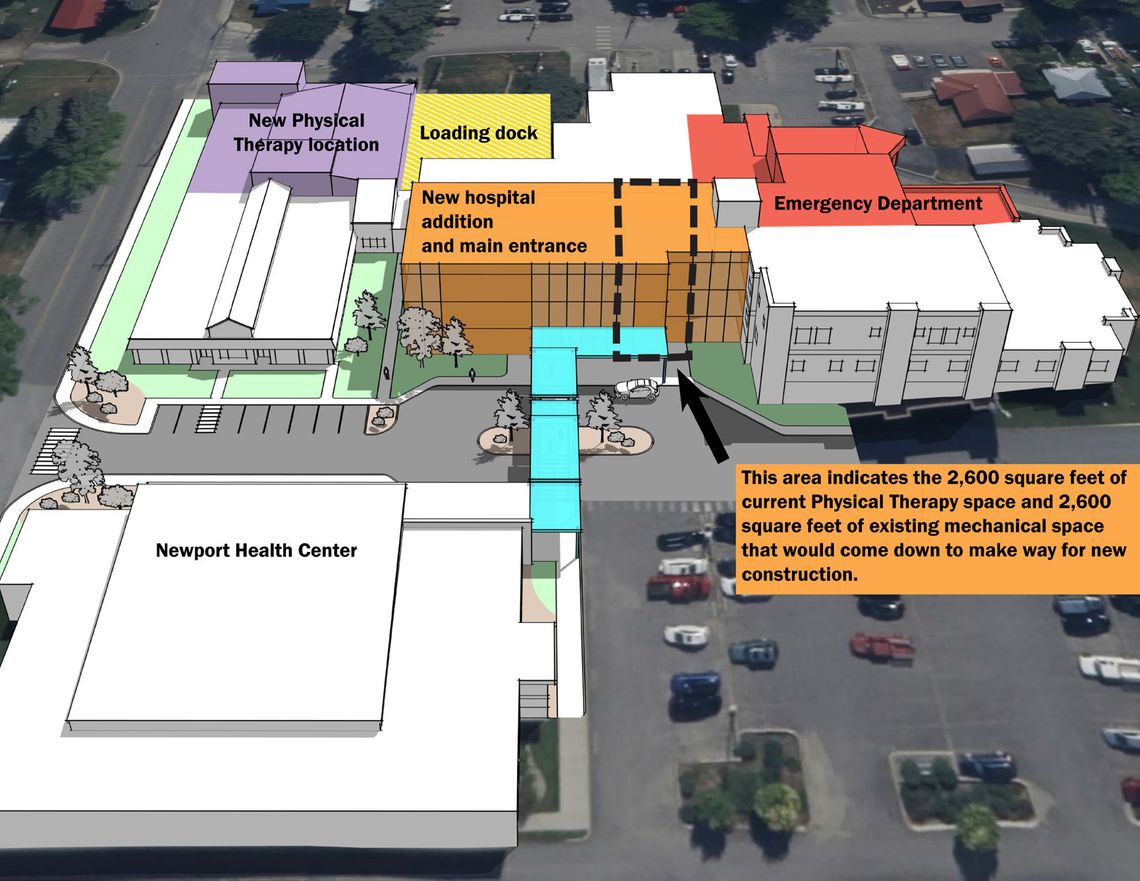
Capacity would increase in the laboratory and rehabilitation therapy spaces, addressing long waits for test results and standard physical therapy treatment at NHHS. There are also plans to move the MRI suite from a trailer to an in-house unit.
Besides those, the project would replace the 1950s-era building with a new three-story addition, and relocate the main entrance to improve patient access and internal flow between services. The relocated main entrance would face Newport Health Center.
“It would bring our costs down actually for services, if we could be more efficient,” Manus said.
Manus acknowledged concerns about non-Pend Oreille County residents visiting NHHS, stating that almost one-third of the district’s business is from Idaho. She countered that business from Idaho facilitates the growth of NHHS’s medical staff and services, in turn benefiting Pend Oreille County residents.
“In the clinic alone, we have 22 providers working out of there, and we have surgeons that are wanting to do more and more time here,” Manus said. Upon completion, the project is expected to support 20–25 new jobs.
Public Hospital District No. 1 completed in 2025 a market assessment that included analysis of demographic trends, service utilization and patient origin data, as previously reported by The Miner. The assessment identified that some residents traveled as far away as Spokane or Coeur d’Alene to access certain healthcare services. Moreover, patients have waited up to six months to see a cardiologist in Spokane and even longer for orthopedic surgeries and other procedures, taking time away from work and home life.
This assessment was used in choosing the project’s priorities, along with a community health needs assessment and input from local healthcare providers and department leaders, according to NHHS’s website.