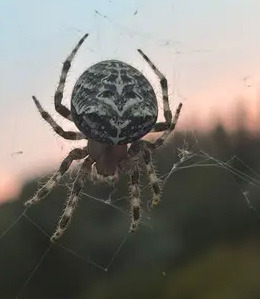
In Spokane, a cat-faced orb weaver waits head-down for insect prey on her spiral web. Note the two conical, ear-like bumps on the top front of the spider’s large abdomen and two indentations that resemble eyes.
If any spider can be described as cute, it’s the cat-faced orb weaver. Never mind that it has eight legs and eight eyes and builds webs that you could walk into face-first in your yard or on a hiking trail.
You see, this medium-sized spider has a cat-like face, just as its common name suggests. And the weeks leading to Halloween is when you’re most likely to see it. Here kitty, kitty.
And what a sight it is. The cat-faced orb weaver has a large, round abdomen with two pointy protrusions that look like feline ears and tiny indented markings that resemble a pair of eyes and a nose.
It’s mostly the females we’re seeing this time of year, said entomologist Richard Zack of Washington State University. Having reached their full adult size, they are actively feeding as they prepare to lay silk-covered egg sacs before winter’s chill sets in.
They’re more visible not because there’s more of them, but because they’re active and plump, Zack explained.
A bulbous spider donning cat ears that spins big webs? Don’t worry, like the majority of spider species, the catfaced orb weaver isn’t dangerous to people or pets.
“They are large, beautiful critters that are very gentle,” Zack said.
Scientifically known as Araneus gemmoides, the catfaced orb weaver is part of a sprawling family of spiders known as Araneidae, with 3500 species worldwide and 180 in North America, according to the Entomological Society of America. They build wheel-shaped webs of Halloween fame that can span 2 feet, complete with anchor lines, spokes and a hub.
Lots of cat-faced orb weavers live here in the Inland Northwest, erecting their handiwork in gardens, tall grasses, shrubs and along walkways.
MADISON EL-AYACHE
“On the east side of Washington, one of the most commonly encountered orb weavers is the cat-faced orb weaver,” according to the Washington State University Extension publication “Common Spiders of Washington.”
You even might find one these outdoor spiders’ webs on your porch, deck or just outside a window. Why? Because artificial lighting draws a steady supply of moths, beetles and mosquitoes for them to eat, according to research. In fact, several studies suggest that orb weavers are larger and carry more eggs when they set up shop in urban areas near man-made lights.
We should have a few more weeks to enjoy cat-faced orb weavers and their eye-catching webs.
Each intricate web is a reminder of the tiny, eight-legged engineers that share our landscapes while keeping insect populations under control.
Not only do cat-faced orb weavers have a flair for design, but they’re also fast builders. Whether a web is damaged by strong winds or torn down by a panicky human, the undaunted spider will probably have it rebuilt by breakfast time the next morning.